Self help messiah, p.13
Self-help Messiah, page 13
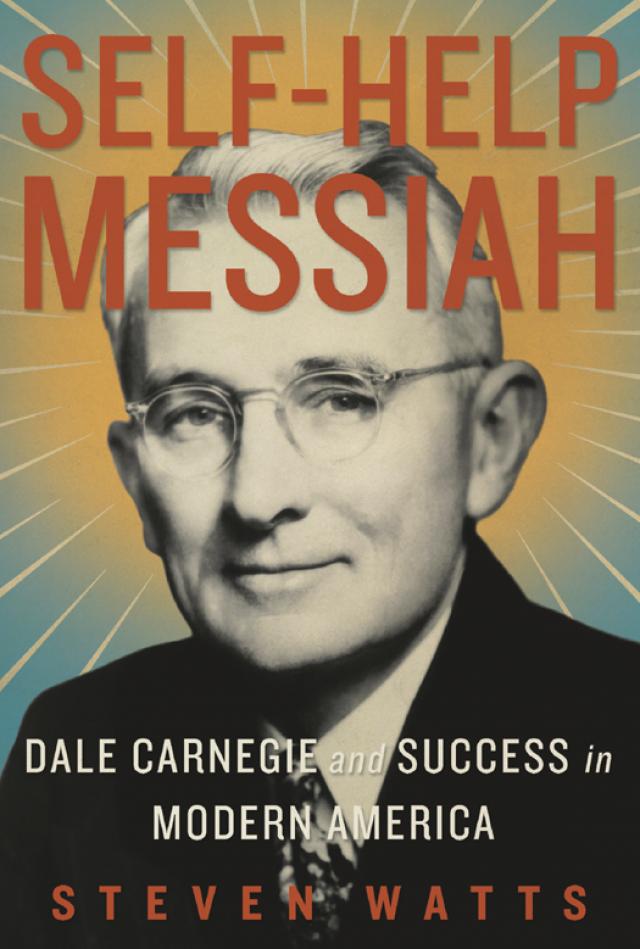


Dale Carnagey once recalled that as a teenager he had heard his mother speak excitedly about the “new century that was going to usher in great and lasting changes.” In his opinion, however, she had underestimated the sweeping transformation that altered the conditions of American life in the early 1900s. “It was more astonishing than even she could have dreamed it would be,” he wrote. “The automobile that changed our transportation habits; the vast changes in the way we spend our leisure time—radio, motion pictures, television; the electric light and telegraph, the airplane—inventions and events destined to have a profound effect upon our civilization and all the generations that follow us.”3
But perhaps the most striking element of modernity for young Carnagey was an intellectual movement overhauling the understanding of human nature and behavior in the early twentieth century. That was psychology, of course, and in the mid-1910s he was fascinated by it. This preoccupation flowed from a broader project. By his own account, eager to move ahead in society, Carnagey had begun a program of study and self-improvement after arriving in New York. He cultivated a habit of making notes, carrying a small notebook in his hip pocket at all times. Whenever he saw something interesting, had a significant idea regarding an important topic, or came across a good story or a striking illustration, he entered it in his notebook. He also began a filing system for keeping track of articles he read, using large yellow manila envelopes as files and filling them with newspaper clippings, magazine extracts, and personal notes.4
Along the same lines, Carnagey embarked upon a program of reading. An elderly, eminent public speaker, with whom he had struck up a friendship, urged him to build a “reserve power” of knowledge by reading seriously in history, literature, science, and philosophy. This would provide him the means to enhance his personal “magnetism.” The young man did not reveal the identity of this figure, describing him only as “the most notable lecturer in our state,” “venerable,” “white-haired,” and an analyst of the dynamic mental powers of figures such as Rudyard Kipling, the actor Richard Mansfield, and Ida Tarbell. It is likely that Carnagey’s anonymous mentor was Orison Swett Marden, the famous lecturer and writer on self-improvement, who matched that description and played a central role in Carnagey’s writings on public speaking, where he was frequently quoted and fulsomely praised.5
But regardless of his mentor’s identity, Carnagey began to read widely in the 1910s as he labored to build up his “mental reserve power.” In his words, he entered into “the delightful dominion of books.” Establishing a routine of reading on Monday, Tuesday, and Friday evenings, he stocked his storehouse of knowledge and came to appreciate “the difference that one usually feels between the educated and the unread man: the one has a vast store of reserve power; the other’s knowledge and experiences have been limited to his own narrow sphere.” This self-education project brought Carnagey into contact with a wide sphere of intellectual endeavors as he encountered works in history, philosophy, the natural sciences, technology and inventions, and what would become a special interest, biographies. But significantly, he usually did so secondhand. He demonstrated a preference for compendia and condensations and sketches—his good friend Homer Croy once observed that Carnagey “wants everything condensed: books, speeches, newspapers, magazines. He is condensation’s greatest zealot”—and thus devoured volumes such as Great Books as Life Teachers by Newell Dwight Hillis and Ridpath’s History of the World by John Clarke Ridpath. He especially became a fan of the Chautauqua Course of Reading, a program of home study that he highly recommended in his YMCA lessons.6
The young man’s expanded reading also brought him into contact with contemporary currents of thought, debate, and discussion. Some of this involved current social and political affairs, as evidenced by references to figures such as Theodore Roosevelt and Woodrow Wilson, John D. Rockefeller and Andrew Carnegie. More significantly, Carnagey was attracted to an important cultural crusade in early twentieth-century America: the New Thought movement, or “positive thinking.” Emerging in the late 1800s and gathering influence and adherents in the early 1900s, this loose movement aimed at the acquisition of “health and wealth and peace of mind” through mental power, which held the key to emotional and material abundance. Important advocates included Phineas P. Quimby, the self-educated founder of mental healing; mystical metaphysicians such as Ralph Waldo Trine with his best-selling book, In Tune with the Infinite; mind-cure advocates such as Annie Payson Call; and Mary Baker Eddy, the founder of Christian Science. New Thought advocates believed that hidden mental resources could be retrieved and mobilized to increase emotional vigor, social success, and material accumulation. Overall, these positive thinkers stressed the galvanizing, restorative, generative power of the human mind. An eclectic group, some drew upon a religious mind-cure impulse while others mined a vein of old-fashioned Emersonian transcendentalism with its notions of an “oversoul” and intuition as a window into reality. Many drew upon psychology, the new science engaged in the exploration of mental impulses and capacities.7
Synthesizing this variety of religious, scientific, and philosophical influences, New Thought spread out over the American cultural landscape in the early 1900s, promoting several broad ideas. Its disciples contended that the human mind was the primary causative force in the universe; that the remedy for human defects and disorders lay in the mental and spiritual realm; and that evil was not a permanent reality in the world but merely the temporary absence of good. Finally, and most important for Carnagey, they insisted that health and material abundance were available to those who mobilized their available mental resources to pursue it. To this end, New Thought disciples underscored the importance of personal magnetism, positive thinking, and personality development for the aspiring individual. As the movement’s influence grew in the early 1900s, it attracted adherents ranging from the eminent philosopher and psychologist William James to popular magazines such as Good Housekeeping, which by 1908 ran a regular column for women entitled “How to Become Beautiful by Thought.”8
Though never formally affiliated with any New Thought group, Carnagey displayed a clear affinity for their beliefs. His involvement was somewhat haphazard, of course—he made no pretense of being an intellectual devoted to sustained, disciplined critical thought—and he had only a dim awareness of the broader implications of New Thought. But numerous references and citations in his writing revealed his attraction to, and inspiration by, key figures, texts, and ideas in this movement. He punctuated practical directives for aspiring public speakers—develop self-confidence, conquer fear, generate enthusiasm, radiate sincerity—with a steady drumbeat of advice on how to do the most important thing of all: gathering and galvanizing one’s mental powers.
In 1915, Carnagey wrote that an individual’s neglect of mental development created stagnation but “there is promise of better things as soon as the mind detects its own lack of thought power.” He recommended several books on “the management of thought,” and quoted a psychologist who stressed the importance of mustering mental powers: “Mental energy and activity, whether of perception or thought, thus concentrated, act like the sun’s rays concentrated by the burning glass. The object is illumined, heated, set on fire.” At one point, Carnagey declared bluntly, “Your success or failure as a speaker will be determined very largely by your thoughts and your mental attitude.”9
Carnagey’s enthusiasm for psychology and New Thought, while partly a result of intellectual engagement, also developed out of his growing success with teaching adults. By 1916, he had left behind the intermittent paychecks and cockroach-infested boardinghouses of his early days in New York. Now students were streaming in to sign up for his YMCA courses, and his income rose and solidified. He was able to find a comfortable apartment in Manhattan and rent an office for himself at Studio 824 in Carnegie Hall. Young Carnagey “was doing well,” wrote one journalist, and he was able “to hire halls around town where ambitious young men were nightly exhorted to Speak Out, to Go In There and Fight, to Wham It Across, and to Keep Their Hands Out of Their Pockets.”10
One of Carnagey’s students at this time described the confident, inspiring teacher he encountered in the class. Frank Bettger had been a professional baseball player—he was third baseman for the St. Louis Cardinals—when a badly broken arm ended his career prematurely in 1911. Returning to his hometown of Philadelphia, he tried to earn a living as a debt collector and then as a life insurance salesman, but a shy personality hamstrung his efforts and he spiraled downward into hard times. Bettger came to realize, in his own words, that he had to “overcome this timidity and fear of talking to strangers.” Hearing about Dale Carnagey’s course at the YMCA on Arch Street, and its success in helping people to overcome such problems, he enrolled in 1917. He met the instructor, who immediately put him in front of the class for a brief talk on why he was there. The terrified Bettger survived the ordeal and set to work bolstering his self-confidence. Progress was slow. Then one evening, Carnagey stopped him in the middle of a listless speech and insisted that he “put some life and animation into what you say.” In Bettger’s words, the teacher then “gave our class a stirring talk on the power of enthusiasm. He got so excited during his talk, he threw a chair up against the wall and broke one of its legs.” The aspiring salesman went home and concluded that he needed to put the same enthusiasm into selling that he put into baseball, and went on to become fabulously successful in his field. The decision he made that night under Carnagey’s tutelage, Bettger wrote later, “was the turning point in my life.”11
So successful were Carnagey’s teaching efforts that he expanded his public-speaking course into a nationwide endeavor. In 1917, he put together an advertising pamphlet for the Carnagey Course in Public Speaking, which listed endorsements from an array of businessmen in New York, Philadelphia, Baltimore, Newark, and Scranton. He began training instructors and codifying his methods in a series of guidelines, lessons, and pamphlets. Carnagey gathered these materials and published them in 1920 as Public Speaking: The Standard Course of the United Y.M.C.A. Schools. This volume—a collection of four “books” and sixteen multi-section “lessons”—offered a complete map of his pedagogical techniques and a sketch of his developing philosophy of individual success and human relations.12
The book expropriated large chunks of material from The Art of Public Speaking, but it also promoted the classroom techniques he had developed in the trenches—prodding students to conquer their fear, establishing regular bouts of speaking, arousing enthusiasm, encouraging natural delivery and gestures, striving to build confidence and self-expression. These qualities became hallmarks of his post-Victorian approach to instruction.
But perhaps most striking, positive thinking pervaded many portions of Public Speaking: The Standard Course. “Every man has in him dormant powers of which he never dreams,” Carnagey claimed, and he argued that speaking was “the shaft which, sunken into the mine of our minds, reveals to others the riches planted there.” Noting again William James’s claim that “the average man develops only ten percent of his mental powers,” Carnagey asserted that his greatest reward as a teacher was “an inner realization of my own progress and the uncovering and fruition of my hidden powers.” He stressed that liberating muffled mental capacities would create a powerful willpower in the individual. “Will to win and keep on willing; and you will possess a power that is as real as a cannonball,” he wrote. “You can’t see it. You can’t lay your hands on it. You can hardly describe it. But it will make you irresistible.”13
Carnagey larded the book—even more than his earlier effort with Esenwein—with frequent references to iconic figures in the New Thought crusade. In particular, he embraced a quartet of men who had helped popularize the message that mental exertion and positive thinking would lead to happiness and material success. The first, Reverend Russell H. Conwell, was one of the great success avatars in American history. Born into a farm family of modest means in the Massachusetts countryside in 1843, he had fought in the Civil War and then toured the world and drifted through a variety of vocations as a young man—lawyer, journalist, and finally, Baptist minister. In the 1880s he became head of the Grace Baptist Church in Philadelphia, which he soon built up to a staggering size of more than four thousand members. Conwell, a man of prodigious energy, also founded Temple University and three hospitals in the Philadelphia area. He became most famous, however, for his “Acres of Diamonds” speech, which he first penned in the 1870s before crisscrossing the country to deliver it more than six thousand times in the succeeding decades. (He gave away much of the wealth he earned from this lecture to send poor young men to college.) This legendary address put forward two central ideas, which Conwell presented with great panache and an actor’s gift for mimicry and impersonation. First, he declared that opportunity lay everywhere in American society, most likely in one’s immediate environment, and that keen attention to producing what people wanted or needed would deliver “acres of diamonds.” Second, he denounced the old religious idea that virtue was related to poverty and declared, “I say that you ought to get rich, it is your duty to get rich. Money is power, and you ought to be reasonably ambitious to have it. You ought because you can do more good with it than you could without it.”14
By the 1910s, however, Conwell began to stress something that New Thought adherents like Carnagey found especially congenial: the crucial role of individual thought and will in achieving wealth. In a 1916 American Magazine article, Conwell stressed that “willpower is your greatest asset” and quoted from Proverbs: “As a man thinks, so he is.” In a booklet issued the following year, Conwell moved further in this direction. The “first essential” in achieving success was “to gain a full appreciation of the latent or unused force which each individual possesses,” he declared. An admiring Carnagey praised Conwell’s demonstration that “If the thought beneath your words is warm, fresh, spontaneous, a part of your self, your utterance will have breath and life.” He also reprinted the entire “Acres of Diamonds” address as a “Special Lecture” in Public Speaking: The Standard Course.15
A second New Thought hero was Elbert Hubbard, who likewise became an inspiration for Carnagey. Born in 1856 near Bloomington, Illinois, this son of a religious farm family began his career as the successful manager of a soap company. A restless intellect, however, prompted him to abandon business in the 1890s. He became a disciple of William Morris and the Arts and Crafts movement and founded The Philistine, an iconoclastic magazine that promoted literary innovations, political reform, and traditions of craftsmanship. Describing himself as “a businessman with a literary attachment,” Hubbard became a writer, editor, and publisher and churned out a steady stream of books and articles on success and happiness. He achieved national fame with “A Message to Garcia,” an ode to an individual initiative set during the Spanish-American War, which castigated the average American’s “inability or unwillingness to concentrate on a thing and do it.” This had created an atmosphere, Hubbard argued, where “slipshod assistance, foolish inattention, dowdy indifference, and half-hearted work seem the rule.” The successful man, he insisted, was the individual who decided “to be loyal to a trust, to act promptly, concentrate their energies: do the thing [the task] at hand.” For Hubbard, “Civilization is one long, anxious search for just such individuals.”16
Like Conwell, Hubbard developed a New Thought sensibility in the early 1900s. In books such as Love, Life and Work (1906) and The Book of Business (1913), he stressed that aspiring individuals needed to enhance their mental powers in order to succeed. “Success is the result of mental attitude, and the right mental attitude will bring success in everything you undertake,” he instructed. “The Master Man is a person who has evolved Intelligent Industry, Concentration, Self-Confidence, until these things become the habit of his life.” Carnagey became a devoted fan of Hubbard. He described “A Message to Garcia” as a “tremendous little tract,” and was especially taken with Hubbard’s axioms about developing the “right mental attitude.” He often utilized this one: “Try to fix firmly in your own mind what you would like to do, and then without violence of direction you will move straight to the goal … Keep your mind on the great and splendid thing you would like to do, and then, as the days go gliding by, you will find yourself unconsciously seizing the opportunities that are required for the fulfillment of your desire.”17
James Allen, the eccentric English writer and metaphysician, became a third New Thought influence on Carnagey. Born in 1864 and orphaned when his father migrated to America and was murdered, Allen left school, became a clerk to support his family, and worked for several British manufacturers until 1902. Interested in spiritual and philosophical issues, he began to write for The Herald of a New Age, and he finally quit business to launch his own magazine, The Epoch. At the same time, Allen began to write a series of short, reflective, inspirational volumes on individual success and happiness, which poured out over the next nine years until his death in 1912. A slight, frail man with long, dark hair who habitually dressed in a black velvet suit, this sage attracted many disciples in New Thought circles with his various writings extolling the possibilities of mind power.18
His best-known work, As a Man Thinketh, presented Allen’s belief that mental exertions could alter both internal states and external circumstances. The human mind was like a garden, he claimed, and “a man may tend the garden of his mind, weeding out all the wrong, useless, and impure thoughts, and cultivating toward perfection the flowers and fruits of right, useful, and pure thoughts.” This would produce much more than abstract goodness. “The outer world of circumstances shapes itself to the inner world of thought,” he contended. “Let a man radically alter his thoughts, and he will be astonished at the rapid transformation it will effect in the material conditions of his life.” The success seeker needed to begin by shaping his own mind. “All that a man achieves and all that he fails to achieve is the direct result of his own thoughts,” Allen maintained. “A man can only rise, conquer, and achieve by lifting up his thoughts. He can only remain weak, abject, and miserable by refusing to lift up his thoughts.”19