Arias

Arias

Sharon Olds

Sharon Olds

Following her recent Odes, the Pulitzer Prize-winning poet gives us radical new poems of intimate life and political conscience, of race and class and a mother's violence.The atom bomb, Breaking Bad, Rasputin, the cervix, her mother's return from the dead: the peerless Sharon Olds once again takes up subject matter that is both difficult and ordinary, elusive and everywhere. Each aria is shaped by its unique harmonics and moral logic, as Olds stands center stage to sing of sexual pleasure and chance wisdom, and faces the tragic life of our nation and our planet. "I cannot say I did not ask / to be born," begins one aria, which considers how, with what actions, with what thirst, we each ask for a turn, and receive our portion on earth. Olds delivers these pieces with all the passion, anguish, and solo force that make a great performance, in the process enlarging the soul of her reader.
Read online
  • 625
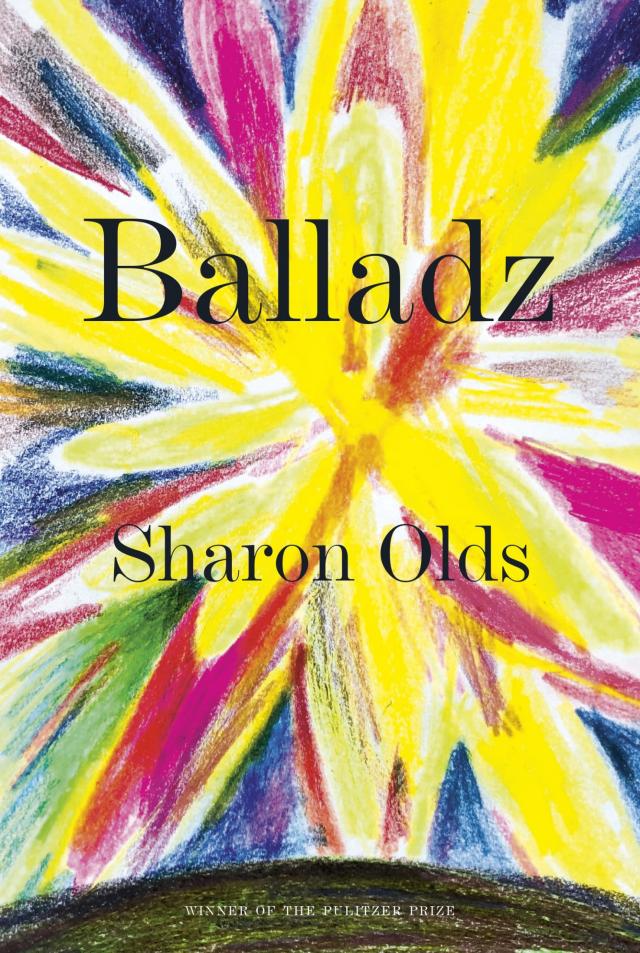
Balladz

Balladz

Sharon Olds

Sharon Olds

NATIONAL BOOK AWARD FINALIST • Songs from our era of communal grief and reckoning—by the Pulitzer Prize and T. S. Eliot Prize for Poetry winner, called "a poet for these times, a powerful woman who won’t back down" (San Francisco Chronicle)."At the time of have-not, I look at myself in this mirror," writes Olds in this self-scouring, exhilarating volume, which opens with a section of quarantine poems, and at its center boasts what she calls Amherst Balladz (whose syntax honors Emily Dickinson: "she was our Girl - our Woman - / Man enough - for me") and many more in her own contemporary, long-flowing-sentence rhythm. Olds sings of her childhood, young womanhood, and maturity all mixed up together, seeing an early lover in the one who is about to buried; seeing her whiteness, seeing her privilege; seeing her mother (whom her readers will recognize) "flushed exalted at Punishment time"; seeing how we've spoiled the earth but carrying a stray indoor...
Read online
  • 216
The Gold Cell

The Gold Cell

Sharon Olds

Sharon Olds

A new collection by the much praised poet whose second book THE DEAD AND THE LIVING, was both the Lamont Poetry Selection for 1983 and winner of the National Book Critics Circle Award.From the Trade Paperback edition.
Read online
  • 55
Strike Sparks

Strike Sparks

Sharon Olds

Sharon Olds

A powerful collection from one of our most gifted and widely read poets--117 of her finest poems drawn from her seven published volumes.Michael Ondaatje has called Sharon Olds's poetry "pure fire in the hands" and cheered the "roughness and humor and brag and tenderness and completion in her work as she carries the reader through rooms of passion and loss." This rich selection exhibits those qualities in poem after poem, reflecting, moreover, an exciting experimentation with rhythm and language and a movement toward an embrace beyond the personal. Subjects are revisited--the pain of childhood, adolescent sexual stirrings, the fulfillment of marriage, the wonder of children--but each recasting penetrates ever more deeply, enriched by new perceptions and conceits.Strike Sparks is a testament to this remarkable poet's continuing and amazing growth.From the Hardcover edition.
Read online
  • 41
Stag's Leap

Stag's Leap

Sharon Olds

Sharon Olds

A stunningly poignant sequence of poems tells the story of a divorce, embracing strands of love, sex, sorrow, memory, and new freedom.In this wise and intimate telling--which carries us through the seasons when her marriage was ending--Sharon Olds opens her heart to the reader, sharing the feeling of invisibility that comes when we are no longer standing in love's sight; the surprising physical passion that still exists between a couple during parting; the loss of everything from her husband's smile to the set of his hip. Olds is naked before us, curious and brave and even generous toward the man who was her mate for thirty years and now loves another woman. As she writes in the remarkable "Stag's Leap," "When anyone escapes, my heart / leaps up. Even when it's I who am escaped from, / I am half on the side of the leaver." Olds's propulsive poetic line and the magic of her imagery are as lively as ever, and there is a new range to the music--sometimes headlong,...
Read online
  • 39
One Secret Thing

One Secret Thing

Sharon Olds

Sharon Olds

Sharon Olds completes her cycle of family poems in a book at once intense and harmonic, playful with language, and rich with a new self-awareness and sense of irony.The opening poem, with its sequence of fearsome images of war, serves as a prelude to poems of home in which humor, anger, and compassion sing together with lyric energy—sometimes comic, sometimes filled with a kind of unblinking forgiveness. These songs of joy and danger—public and private—illuminate one another. As the book unfolds, the portrait of the mother goes through a moving revisioning, leading us to a final series of elegies of hard-won mourning. One Secret Thing is charged throughout with Sharon Olds’s characteristic passion, imagination, and poetic power.The doctor on the phone was young, maybe on hisfirst rotation in the emergency room.On the ancient boarding-school radio,in the attic hall, the announcer had given myboyfriend’s name as one of twobrought to the hospital after the sunriseservice, the egg-hunt, the crash—one of themcritical, one of them dead. I was looking at thestairwell banisters, at their lathing,the necks and knobs like joints and bones,the varnish here thicker here thinner—I had saidWhich one of them died, and now the world wasan ant’s world: the huge crumb of eachsecond thrown, somehow, up ontomy back, and the young, tired voicesaid my fresh love’s name.from “Easter 1960”From the Trade Paperback edition.From Publishers WeeklyThe ninth outing from Olds (Blood, Tin, Straw) should again please the many admirers of her raw, vivid and often explicit poems, but might surprise few of them—until the end. As in all her books, Olds works in a demotic free verse, driven by rough enjambments and shocking comparisons: she devotes much of her energy (three of five sections here) to sex, remembered pain and parenthood—the dramatic, abusive household in which she grew up and her tender relationship with her own daughter. Olds depicts the traumas of her first decades with undeniable, if occasionally cartoonish, force: When I think of people who kill and eat people,/ I think of how lonely my mother was. Olds can also offer high-volume poetry of public protest, as in the set of sonnet-sized poems against war with which the book begins. What seems new here are Olds's reactions to her mother's last years, and to her mother's death. On an antidepressant, briefly adorable, and then in failing health, my mother sounds like me,/ the way I sound to myself—one/ who doesn't know, who fails and hopes. Both the failures and the hopes find here a voice that takes them seriously. (Sept.) Copyright © Reed Business Information, a division of Reed Elsevier Inc. All rights reserved. From BooklistStarred Review An audacious virtuoso, Olds shares perceptions so archaic they predate consciousness and tells of dark deeds worthy of Greek myths transpiring in an otherwise ordinary middle-class, mid-twentieth-century American household. What makes her work so potent is her countering of the shock and shiver of her baroquely bloody revelations with poetic structures so refined and sturdy, they have something of the Shaker about them, minus, of course, the celibacy. Olds is a moralist, and she does believe in confession, in expiation, as long as it is contained in clean-lined, well-keeled vessels. In another breathtaking collection, Olds begins with “War,” a portrait gallery of the displaced, the maimed, and the cruel, iconic poems as haunting as paintings by Goya. She then extends her long series on family trauma, writing with chilling restraint of moments of malevolent selfishness, brutality, and weirdness. But Olds also writes with tremendous assertion about a tormented girl’s revenge as she comes into womanhood, and here Olds sees her fierce mother gentled by age and illness, their terrible adversity canceled as death nears. This is a pivotal collection, and Olds signals a sea change in moments of gleeful self-mockery and resounding catharsis. --Donna Seaman
Read online
  • 10
183