Her honor, p.1
Her Honor, page 1
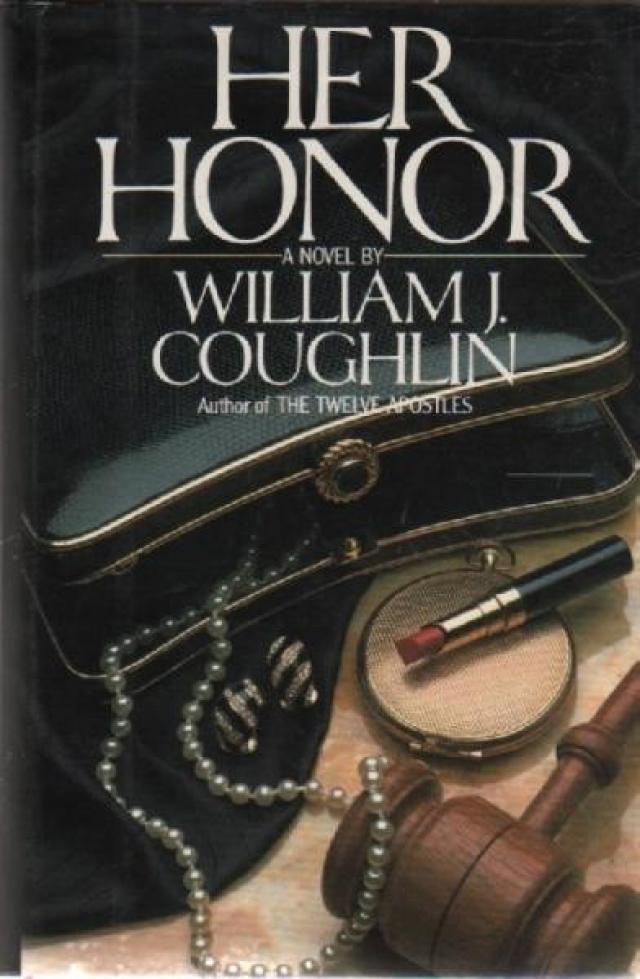


HER HONOR
William J. Coughlin
First published by
New American Library
June 1987
“Oozes with money, power, glamour, greed, sex and scandal” was how the critics described The Twelve Apostles, William Coughlin’s scorching novel about a ravenous new breed of lawyers. Now, in the same tradition, comes HER HONOR, William Coughlin’s brilliant new “insider” novel about the law and a woman judge’s struggle to balance love and honor on the unpredictable scales of justice.
When beautiful young Kathleen Talbot is assigned her first important case as a circuit court judge, she must confront more than the trial at hand. The case on the docket—a controversial “mercy” killing of a brain-dead victim by a vengeful officer—is a painful reminder of her own decision to have her terminally ill father’s life-support system cut off. Kathleen sees no reason to disqualify herself since the issue and motive behind this court case are very different from the circumstances that surrounded her father’s death, but as the trial progresses, Kathleen realizes that she, too, has been put on trial.
Still, Kathleen’s sense of honor impels her to proceed with the trial regardless of pressure and consequences. When she finds herself irresistibly attracted to Jeremiah Mitchell, the handsome, charismatic attorney for the defense, things become even more complicated. Despite her efforts to try to keep the relentless politics of the court from defeating her, the case explodes into hideously accusing headlines….
Only author William J. Coughlin, himself a judge, could provide such an authentic and chilling look into the hidden chambers of power in the judicial system—and reveal the cynicism and corruption of political favors and deals practiced on every level of the courts. HER HONOR is at once a stunning legal drama and the very human story of a beautiful and brilliant woman’s pride, passion, and honor.
WILLIAM J. COUGHLIN has combined a career as a United States administrative judge in Detroit with that of a bestselling novelist. His two previous highly acclaimed and successful novels were THE TWELVE APOSTLES and HER FATHER’S DAUGHTER.
Praise for
HER HONOR
“HER HONOR is fascinating, a crackling and insightful book. I loved it.”
—Robert B. Parker,
author of the Spenser series
“Combines a compelling insider’s knowledge with a powerful storyline. If you want to learn about the way it really is inside a courtroom and also be royally entertained, read this book….William Coughlin is habit-forming.”
—James B. Patterson,
Edgar Award-winning author of
The Thomas Berryman Number
“Enjoyable, informative…a well-written page-turner that gives insight into backroom judicial politics.”
—Stanley Shapiro,
producer and author of
A Time To Remember
OTHER BOOKS BY
WILLIAM J. COUGHLIN
Her Father’s Daughter
The Twelve Apostles
No More Dreams
Day of Wrath
The Stalking Man
To Margaret Ann, William Jude,
Susan Marie, Dennis John,
Patrick Thomas, and Kathleen Mary
Chapter 1
THE RECEPTION ROOM for the prosecuting attorney faced the corridor, and Tina Welch’s desk was placed so she would have a view of everyone who approached. Tina watched as her boss, Kathleen Talbot, strode along the long corridor toward the office. She was amused to see that the policeman assigned as Kathleen’s bodyguard had to hustle to match the quick pace set by the young prosecuting attorney.
“Good morning, Tina.” Kathleen nodded as she entered. “What’s today’s schedule look like?”
“Nothing unusual. Marty Kelly would like to discuss a murder case with you. He wants to accept a plea, but he’s worried about political consequences.” Tina handed her a batch of telephone messages. “Deputy Commissioner Sloan wants a meeting. He didn’t like what you said the other night at that community dinner.”
“He wasn’t there.”
“He doesn’t like what he was told you said.”
Kathleen’s eyes narrowed. “You tell him that I’m not run by the police department. Tell him if he’s so interested, he might do well to attend some of these meetings himself.” She stopped. “Never mind. Get him on the phone. I’ll tell him myself.”
Men considered Kathleen Talbot stunningly beautiful and they were right. Her streaming, lush, jet-black hair caught and seemed to magnify light, like a dark mirror. Her smooth, perfect features were the classic sort sculptors dreamed of capturing. Tina’s smile was wistful. The young woman, only a few years past thirty, could easily have been her own daughter. Things could have been so different for all of them. But all that was in the past now, reduced by the memory of what might have been. Big Mike Hunt lived in Florida. He had moved there with his latest wife after he retired.
Kathleen was different from her father in almost every way. Big Mike Hunt, a thick, sturdy man, always seemed like packaged thunder, a smoldering, powerful parcel of explosive that could erupt at any moment, always dangerous and often unpredictable.
Kathleen was tall, slim, and elegantly dressed. If Big Mike was fire, his daughter was ice.
To Tina it was the young woman’s dark, beautiful eyes that provoked the sole echo of Kathleen’s sometimes ruthless father. Dark blue, intelligent, quick—like her father’s, her eyes seemed to miss nothing.
Kathleen had held the job of prosecutor for almost three years. She had succeeded Big Mike as the chief law-enforcement officer for the city. The election had been a mere formality once Big Mike gave her his support. Still, she’s a smarter lawyer than her father ever was, Tina thought. He just played the game better.
“Are you going to the funeral home later?” Tina asked before Kathleen disappeared into her office.
“No. I’ll go to Harry’s funeral tomorrow, but I’m not going to waste my time today sitting around and gossiping with a lot of bloated politicians.” Kathleen paused. “Will I have time to go home for dinner before that speech tonight?”
Tina consulted the appointment book. “Doesn’t look like it, Mrs. Talbot. You’re booked solid.”
Kathleen nodded. “As soon as I’m finished with Sloan, send Kelly in.” She paused again. “Did we send flowers?”
Tina nodded. “Oh yes. That’s standard office policy, set up years ago by your father. We seem to be sending flowers more often lately. All the old tigers are dying off.”
“Death is part of the law business. Surely my father told you that?”
Tina smiled. “Not quite in that way, Mrs. Talbot.”
As Kathleen Talbot disappeared into her own office, Tina reflected for a moment before dialing Commissioner Sloan’s number. Lately she found herself wondering if Kathleen was really always so in control, or if she simply had learned to convey that cool impression. She was still a puzzle. Big Mike had been all feeling and emotion. It seemed a shame that some of that throbbing human vitality hadn’t been passed along to his beautiful and only daughter.
* * *
“Look at that.”
“What?”
“The cops, out in front of the place.”
Sullivan was busy watching oncoming traffic, looking for an opening to make a left turn, but he glanced at the funeral home. Four police officers stood guard at the front entrance of the large Georgian-style brick building, two on each side of the tall carved doors. Dressed in starched white hats, white silk scarves, and spotless white gloves, the officers stood at rigid attention, their polished drill rifles held at a precise angle on their shoulders, their dress-blue uniforms crisply pressed.
Sullivan chuckled. “They look like the Buckingham Palace guards, don’t they?”
“More like some second-rate operetta company,” Foley responded. “Absurd, if you ask me.”
Traffic parted and Sullivan was able to turn into the arched vehicle entrance. A traffic policeman from the motorcycle division directed them toward the parking area in the back of the funeral home. The policeman, his helmet and boots polished to a high gloss, recognized them as they drove past and gave them a snappy military salute. He, too, wore spotless white gloves.
“Well, if you were going to stick up a gas station, this is the day to do it. All the cops are here,” Sullivan observed.
Rows of concrete planters divided the parking lot into four long corridors. They rolled slowly past shiny luxury cars as they looked for an empty space. Another motorcycle officer standing near the end of the long row gestured to them.
“I wonder what the taxpayers would say if they knew their high-priced public-safety officers were being used as parking-lot attendants.”
Sullivan had to maneuver the big Cadillac carefully to fit it in the empty space. The policeman was busy directing another car but he took time to salute them as the two men climbed out of their vehicle.
“I hate this goddamned place,” Foley said.
They began to walk slowly toward the funeral home.
“That’s because you know you’ll end up here one of these days,” Sullivan suggested.
“Not necessarily. There’s other places, plenty of them.”
He was answered by a chuckle. “None of them big enough. Besides, it’s a tradition. If a public official dies, and he’s an east-sider, it’s here at Van Claiborne’s. West-siders use Weber’s. People expect it.”
“And Appel’s if they’re Jewish.”
“As I said, tradition.”
“Look up there, at the back of the place.”
The front entrance was mostly for show; the rear entrance facing the parking lot was the funeral home’s main portal. Six officers, dressed identically to the ones in front, stood guard, facing each other, three to a side in front of the big glass doors.
“You’d think a pope died, from the looks of it. The mayor’s responsible for this extravaganza. I wonder why?”
“The mayor remembers who saved his ass; it’s that simple. Suppose Harry had assigned that grand-jury investigation to the wrong judge. The mayor and his staff would have been indicted, convicted, and doing time by now.”
“He assigned that case to Francis Flanigan.”
“Yeah. Francis the Thick, who has a hard time finding the courthouse, let alone a criminal conspiracy. Flanigan gave everyone a nice clean bill of health because he didn’t understand the case in the first place. Giving Francis the case was an inspiration on Harry’s part, and the mayor remembers. This is his way of saying thanks.”
“I still think it’s inappropriate.”
“Look at it this way: the local pope has died. Harry Johnson probably had more power per square inch here than the pope does in Rome. His passing is a momentous occasion and it should be properly marked.”
“This isn’t Rome.”
“No, but it’s a huge, important Northern industrial city. We’re bigger than Cleveland and damn near as important as Chicago. As far as the Midwest goes, this is Rome—we’ve got almost two million people here—and Harry Johnson was our pope, or at least close to it.”
As they approached the files of policemen, Foley said: “Harry was a prick.”
“I didn’t say he wasn’t.”
“He did a lousy job.”
“I agree.”
“It is a lousy job.”
“I agree again.”
“But I want it.”
“So do I.”
“So does everybody. That’s why we’re all here.”
The six policemen saluted as the two judges, Foley and Sullivan, walked between them to enter the funeral home. Inside, their arrival was noted by the cluster of men standing in the long hallway.
Judge Joseph Sadowski nodded toward them as they approached. “Well, it’s official, the Irish Bobbsey Twins just arrived. I wonder if Foley and Sullivan have ever gone anywhere except together?” Sadowski smiled. He was tall, dignified, stem, and the smile seemed out of place. “Do you think they might be queer?”
Tim Quinlan, who had been a judge longer than anyone else there, shook his head. “Foley’s got eight children, Sullivan ten.” A gurgling sound, which was Quinlan’s way of laughing, wheezed from his ancient throat. “I don’t know how they managed that. I suppose one sits at the foot of the other’s bed when they screw. They’re both prudes, so I’m sure they’d keep their eyes closed.” The gurgling wheeze sounded again. “Anyway, they’re Irish and neither of them qualifies as an Irish queer.”
“What’s an Irish queer?” Sadowski asked, knowing he was acting as Quinlan’s straight man.
“That’s a mick who likes women better than he likes whiskey.” Quinlan was the only one who laughed. “Both of them have demonstrated their fondness for the bottle, so they’re okay.”
Judge Jerome Foley was squat, and his square red face had the squinting look of a hostile bulldog. His companion. Judge Michael Sullivan, was a complete contrast, tall, painfully thin, and with the dreamy look of an ancient saint. Foley, despite his ferocious look, had the reputation among lawyers as being a soft touch, while Sullivan, the saintly, was said to delight in quiet viciousness. Both were in their late fifties, and both were circuit judges.
“Hello, Jerry. Hello, Mike,” Sadowski greeted them. “A sad occasion.”
Sullivan’s smile conveyed the sweet sorrow of a professional mourner. “Depends upon your point of view, I suppose.” He glanced in at the viewing room, which was packed. “Someone said Harry bit himself in his sleep.”
Quinlan’s wheeze caused several people in the viewing room to turn. He inhaled deeply, then nodded to those who seemed concerned as if to show he was fully recovered. “Our late leader,” Quinlan said quietly, “according to the story being given out by the family, got pissed off at a neighbor’s barking dog and was on his way over to brain the offending creature when he blew an infarct. Dead before he hit the ground, they say. Anyway, that’s the official version.”
Sadowski nodded as if about to impart a solemn judgment. “I knew that temper of his would get him one day. I told him so. Harry was always in a smoldering rage about something. It was bound to happen. Still, there are far worse ways to die.”
“Of course, it didn’t happen exactly like that,” Quinlan said, his voice near a whisper. “He was over at Brenda’s, so the cops tell me. Passion over the age of fifty can be dangerous. Brenda apparently got most of his clothes back on before she called.”
They stood in embarrassed silence for a few minutes.
“Has the governor shown yet?” Foley asked, relieving the tension, as he studied the people crowding into the funeral home.
“No,” Sadowski said. “I expect he’ll pop in here a few minutes before the Masons begin their service. You know him, fast in, fast out. He has these things timed to the second.”
“How’s the family taking it?” Sullivan asked. “Given the circumstances…”
Everyone looked embarrassed.
“The widow’s playing the usual role, looking properly solemn, if that’s what you mean. The kids are pretty shook-up.”
“The kids are pretty old by now,” Foley said.
“The boy, the doctor, is about thirty. The daughter’s a bit older.”
“They know about Brenda?”
No one answered Foley’s question.
Finally Quinlan said quietly, “Jerry, that’s hardly the thing you go around asking the widow: did you know that your late husband was screwing a female judge, or did you just find out? Of course, she’s in there, so if you want to ask, feel free.”
“Brenda’s in there?”
Quinlan scowled. “No. The widow.”
“Anybody seen Brenda?” Foley persisted. “It must have been a hell of a shock for her.”
Sadowski coughed decorously. “Brenda, I understand from the assignment clerk, has taken a few days’ leave, canceled her docket, and gone to Philadelphia to visit her sister.”
Foley nodded. “Strange, eh? A nice-looking girl like Brenda. Harry Johnson is…was, twenty years her senior, and looked like a dried-out old turkey. I could never understand the attraction.”
“Power,” Sadowski said, his tone implying there was no other answer possible. “Women are always attracted to power. It’s that simple.”
Sullivan’s face showed the glimmer of a small smile. “Perhaps whoever gets Harry’s job will get Brenda too. That’s not a bad perk, all things considered.”
“That brings up a nice little question,” Quinlan said, this time quite serious. “Who’s going to get the job?”
Another awkward silence ensued. Finally Quinlan’s wheeze was heard again.
“I’m too old,” he cackled. “I retire end of the year. So I suppose I’m the only non-candidate here.” He looked in toward the flower-filled viewing room. “They hadn’t got Harry’s body out of Brenda’s place before young Ted Sawchek threw his hat into the ring. But I understand organized labor wants Webster Broadbent to be named.”
Sullivan sighed. “Well, there are thirty-eight circuit judges, and we do the electing. Now that Quinlan here has taken himself out, that leaves only thirty-seven candidates for the job.”
Foley’s expression became even more fierce. “Since it takes a majority vote of the judges sitting, nobody may ever get to perform Harry’s job again.”
Sadowski shook his head. “I’ve been a judge through two of these things. It’s always the same—everybody scrambles at first, but eventually it comes down to two or three leaders. Then the bargaining gets serious and the political pressure groups put the real heat on. It gets ugly, but it gets done.”
“What about the governor? He’ll want a say in who we select,” Foley said.
Sullivan looked down at his short friend. “He gets to appoint Harry’s successor on the bench, but that’s all. We still have full power to name the executive judge. The governor will have to wait outside on that, same as everyone else.”