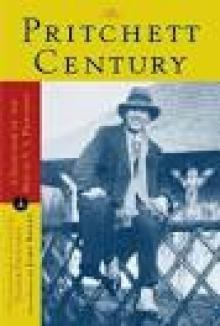
A man of letters, p.1
A Man of Letters, page 1


A Man of Letters
SELECTED ESSAYS
V. S. PRITCHETT
Contents
Preface
British
Henry Fielding An Anatomy ofGreatness
Samuel Richardson Clarissa
Laurence Sterne Tristram Shandy
Thomas Day The Crank
Walter Scott The Heart of Midlothian
Amelia Opie The Quaker Coquette
Lord Byron Letters
Thomas Love Peacock The Proximity of Wine
George Cruikshank A Rough English Diamond
R. S. Surtees The Brutal Chivalry
Charles Dickens Oliver Twist
George Eliot Warwickshire
Lewis Carroll Letters
Anthony Trollope Trollope Was Right
Ford Madox Ford Fordie
Arnold Bennett The Five Towns
E. M. Forster Mr Forster’s Birthday
Evelyn Waugh Club and Country
Virginia Woolf Temperament of Genius
Max Beerbohm A Dandy
Joseph Conrad Conrad
Cyril Connolly The Ruins
American
Edith Wharton New York, 1900
Mark Twain The American Puritan
William Faulkner The Hill-Billies
Henry James The Last Letters
Nathanael West Miss Lonelyhearts
S. J. Perelman The Con-Man’s Shadow
European
Le Sage Sofa and Cheroot
Honore De Balzac La Cousine Bette
George Sand And Lelia
Benjamin Constant A Swiss Novel
Stendhal Playing Stendhal
Marcel Proust Proustifications
Albert Camus Albert Camus
Camille Pissarro Camille Pissarro
Francisco Jose De Goya Goya
Vladimir Nabokov The Supreme Fairy Tale
Eça De Queiroz A Portuguese Diplomat
Machado De Assis A Brazilian
Alexander Pushkin Stories
Mikhail Yurevich Lermontov A Hero of our Time
Fyodor Dostoevsky Dostoevsky’s Wife
Ivan Turgenev Turgenev in Baden
Robert Musil A Viennese
Alessandro Manzoni I Promessi Sposi
List of Books
Preface
If, as they say, I am a Man of Letters I come, like my fellows, at the tail-end of a long and once esteemed tradition in English and American writing. We have no captive audience. We do not teach. We are rarely academics though we owe a great debt to scholars. We earn our bread and butter by writing for the periodicals that have survived. If we have one foot in Grub Street we write to be readable and to engage the interest of what Virginia Woolf called ‘the common reader’. We do not lay down the law, but we do make a stand for the reflective values of a humane culture. We care for the printed word in a world that nowadays is dominated by the camera and by scientific, technological, sociological doctrine. We still believe, with Dostoevsky, that ‘without art a man might well feel that his life was not worth living’. We ourselves have written novels, short stories, biographies, works of travel. Some of us are poets. And we know that literature is rooted in the daily life of any society but that it also springs out of literature itself. The difference between the traditional Man of Letters and us survivors today is that what we have to say must be done in a couple of columns whereas the Victorians – look at Henry James – could go on in the Monthlies and Quarterlys for dozens of pages. When, at the beginning of World War II I was asked to write a page under the title of Books in General, for the New Statesman, paper was rationed in Great Britain and I was soon cut down from 1850 to 1800 words. It was a training in the allusive and laconic style that has remained with me for the fifty years I have given to writing essays such as these in this book.
This selection is taken from pages I have contributed to the New Statesman, the New Yorker, and the New York Review of Books and some from my first book of essays during the War, now out of print. It is strange to look back at the early ones and to remember reading, say, the four volumes of Clarissa in one week or perhaps Gil Bias, Balzac or Turgenev the next, as I travelled by slow trains packed with troops (and from air-raid warning to air-raid warning), to shipyards and factories in the North to report about ‘the war effort’ and to write between the hours of my comic duties with the local militia and fire-watching. Why was I asked to write on these authors? Contemporary writing had stopped. We were left with the major and the minor masters of the past. Air-raid shelters for the mind? Not at all. These authors, we found – to use a phrase common at the time – had also lived in ‘times of transition’, in or ‘between wars’. They were embalmed in their genius but had lived, as we did, in a changing society. Look back and we could see the rogue turning into the Puritan and the Puritan revealing a hidden and even exuberant imagination. We could see Scott evoking a splitting society. We saw literature growing out of life and the common experience. I had fortunately read such books when I was a youth. I had also earned my living in trades that had brought me close to people more diverse than the literary. I was not a product of Eng.Lit. I had never been taught and, even now, I am shocked to hear that literature is ‘taught’. I found myself less a critic than an imaginative traveller or explorer – a slow reader too – moving from sentence to sentence, pausing to see the view and the writer arriving at the clinching detail. I had a double contact with human nature, first as a writer crossing frontiers in Ireland, France, Spain and the Americas and as a traveller in the use of writing in these countries. I was travelling in literature.
V. S. PRITCHETT
Henry Fielding
An Anatomy of Greatness
There are two books which are the perfect medicine for the present time: Voltaire’s Candide and Fielding’s Jonathan Wild. They deal with our kind of news but with this advantage over contemporary literature: the news is already absorbed, assumed and digested. We see our situation at a manageable remove. This is an important consolation and, on the whole, Jonathan Wild is the more specific because the narrower and more trenchant book. Who, if not ourselves, are the victims of what are called ‘Great Men’? Who can better jump to the hint that the prig or cut-purse of Newgate and the swashbuckler of Berchtesgaden are the same kind of man and that Caesar and Alexander were morally indistinguishable from the gang leaders, sharpers, murderers, pickpockets from whom Mr Justice Fielding, in later years, was to free the City of London? Europe has been in the hands of megalomaniacs for two decades. Tyranny abroad, corruption at home – that recurrent theme of the eighteenth-century satirists who were confronted by absolute monarchy and the hunt for places – is our own. Who are we but the good – with a small middle-class ‘g’ – and who are ‘they’ but the self-elected ‘leaders’ and ‘the Great’? And Jonathan Wild has the attraction of a great tour de force which does not shatter us because it remains, for all its realism, on the intellectual plane. Where Swift, in contempt, sweeps us out of the very stables; where Voltaire advises us not to look beyond our allotments upon the wilderness humanity has left everywhere on a once festive earth, Fielding is ruthless only to the brain. Our heads are scalped by him but soul and body are left alive. He is arbitrary but not destructive. His argument that there is an incompatibility between greatness and goodness is an impossible one, but of the eighteenth century’s three scourgers of mankind he is the least egotistical and the most moral. He has not destroyed the world; he has merely turned it upside down as a polished dramatist will force a play out of a paradox:
… contradicting the obsolete doctrines of a Set of Simple Fellows called, in Derision, Sages or Philosophers, who have endeavoured as much as possible to confound the Ideas of Greatness and Goodness, whereas no two Things can possibly be more distinct from each other. For Greatness consists in bringing all Manner of Mischief on Mankind, and Goodness in removing it from them.
Jonathan Wild is a paradox sustained with, perhaps the strain, but above all, with the decisiveness, flexibility and exhilaration of a scorching trumpet call which does not falter for one moment and even dares very decorative and difficult variations on the way to its assured conclusion. When we first read satire we are aware of reading against the whole current of our beliefs and wishes, and until we have learned that satire is anger laughing at its own futility, we find ourselves protesting and arguing silently against the author. This we do less, I think, in reading Jonathan Wild than with Candide or Gulliver. If there is any exhaustion in Jonathan Wild it does not come from the tussle of our morality with his. There is no moral weariness. If we tire it is because of the intellectual effort of reversing the words ‘great’ and ‘good’ as the eye goes over the page. Otherwise it is a young man’s book, very vain of its assumptions and driven on with masterly nonchalance.
To the rigidity of his idea Fielding brought not only the liveliness of picaresque literature but, more important, his experience as a playwright. Of its nature satire deals in types and artifices and needs the schooling of the dramatist, who can sweep a scene off the moment the point is made and who can keep his nimble fingers on a complicated plot. Being concerned with types, satire is in continual need of intrigue and movement; it needs tricks up the sleeve and expertness in surprise. We are distracted in Jonathan Wild between pleasure in his political references (the pointed one on the quarrels between the gangsters about the style of their hats for example, which Wild settles with the genius of a dictator), and the dexterity of the author. ‘Great men are lonely’: one of the best scenes in the book, one fit to stand beside Wild’s wonderful quarrel with his wife Tishy when he calls her a bitch, sets off the farce of Wild’s soliloquy in the boat. Put adrift in an open boat by the Captain who has rescued Heartfree’s wife from Wild’s attempt at rape, Wild has his ‘black Friday’ and muses on the loneliness of ‘the Great’, their fear of death and their unhappiness. Since death is inevitable, Wild cries, why not die now? A man of action, for ever acting to an audience if only an imaginary one, he staggers us by at once throwing himself into the sea. Were we wrong? Was he courageous after all? We knew that a crook lives on gestures, that a show of toughness is all – but were we misreading him? Down comes the curtain, the chapter ends. Its dramatic effect is enormous, quite beyond the reach of the picaresque novelists who depend on the convolutions of intrigue alone. Among the satirists, only Voltaire, another writer for the stage, was capable of Fielding’s scene; Swift was always willing to let a situation ease off into ironical discussion. And then, up goes Fielding’s curtain again: Wild does not die. He is saved. He is in a boat once more. Saved by one of those disillusioning miracles of fiction? Not at all. He is back in his own boat. He swam back to it. Philosophy had told him to die, but Nature, whom he knew had designed him to be Great, told him not to be such a fool. That is a masterstroke.
Such cross-ruffing is the heart of farce and of the ordinary literature of roguery. But as Wild picks the pockets of his accomplices, double-crosses the card-sharping Count, swindles and is swindled in turn, each act shows a further aspect of his character and is a new chapter in the anatomy of Greatness. It has been said that Fielding’s common sense and his low opinion that human beings were moved chiefly by self-interest, restricted his imagination. This may be so, though the greater restriction was to his sensibility. In the light of our present painful knowledge of Great Men of action we are not likely to think the portrait of Wild unimaginative simply because Fielding takes an unheroic view. There is the episode of the jewels. The Count who, with Wild, has swindled Heartfree over the casket of jewels, has double-crossed his partner by substituting paste for the stolen treasure. Worse still, Tishy whom Wild intends to seduce by the gift of the casket, has worked in a pawnbroker’s and knows paste when she sees it. Wild is left to another soliloquy, to the sadness of Berchtesgaden or neo-Imperial Rome. The Great’ are always sad:
How vain is human Greatness!… How unhappy is the state of Priggism! How impossible for Human Prudence to foresee and guard against each circumvention!… In this a Prig is more unhappy than any other: a cautious man may in a crowd, preserve his own Pockets by keeping his hands in them; but while he employs his Hands in another’s pockets, how shall he be able to defend his own? Where is his Greatness? I answer in his Mind; ’Tis the inward Glory, the secret Consciousness of doing great and wonderful Actions, which can alone support the truly Great Man, whether he be a Conqueror, a Tyrant, a Minister or a Prig. These must bear him up against the private Curse and public Imprecation, and while he is hated and detested by all Mankind, must make him inwardly satisfied with himself. For what but some such inward satisfaction as this could inspire Men possessed of Wealth, of Power, of every human Blessing, which Pride, Luxury, or Avarice could desire, to forsake their Homes, abandon Ease and Repose, and, at the Expense of Riches, Pleasures, at the Price of Labour and Hardship, and at the Hazard of all that Fortune hath liberally given them could send them at the Head of a Multitude of Prigs called an Army, to molest their Neighbours, to introduce Rape, Rapine, Bloodshed and every kind of Misery on their own Species? What but some such glorious Appetite of Mind....
Intoxicating stuff. The eighteenth century’s attack on absolutism, its cry of Liberty, its plea for the rational, the measured, and even the conventional culminated – in what? Napoleon. And then democracy. It is painful to listen to the flying Prigs, to democracy’s Jonathan Wild. Was the moral view of human nature mistaken? Is the Absolute People as destructive as the Absolute King? Is the evil not in the individual, but in society? We rally to the eighteenth-century cry of ‘Liberty’; it is infectious, hotter indeed than it sounds today. We reflect that those good, settled, educated, middle-class men of the time of Queen Anne owed their emancipation to a Tyrant who burned half Ireland, killed his King and went in private hysterical dread of the devil. Under that smooth prose, under that perfect deploying of abstractions, the men of the eighteenth century seem always to be hiding a number of frightening things that are neither smooth nor perfect. There is the madness of Swift, there is the torment of Wesley. Or was Fielding imagining the paradise of the anarchists where our natural goodness enables us to dispense with leaders? Sitting under the wings of the flying Prigs, we observe the common, indeed the commonplace, non-combatant man, behaving with a greatness which appears to require no leader but merely the prompting of sober and decent instincts.
Of course if the Great are wicked, the good are fools. Look at the Heartfrees! What a couple! But here again if you have made your head ache over Fielding’s impossible theme, it is cured at once by the felicities to which the Heartfrees drive Fielding’s invention. The letters which Heartfree gets from his impecunious or disingenuous debtors are a perfect collection; and Mrs Heartfree’s sea adventures in which there is hardly a moment between Holland and Africa when she is not on the point of losing her honour, are not so much padding but give a touch of spirit to her shopkeeping virtues and also serve the purpose of satirising the literature of travel. It is hard on Mrs Heartfree; perhaps Fielding was insensitive. Without that insensibility we would have missed the adventure with the monster who was ‘as large as Windsor Castle’, an episode which reminds us that the spirit of the nine o’clock news was already born in the seventeen-hundreds: ‘I take it to be the strangest Instance of that Intrepidity, so justly remarked in our Seamen, which can be found on Record. In a Wood then, one of our Mucketeers coming up to the Beast, as he lay on the Ground and with his Mouth wide open, marched directly down his Throat.’
He had gone down to shoot the Monster in the heart. And we should have missed another entrancing sight. Mrs Heartfree perceived a fire in the desert and thought at first she was approaching human habitation: ‘… but on nearer Approach, we perceived a very Beautiful Bird just expiring in the Flames. This was none other than the celebrated Phoenix.’ The sailors threw it back into the Fire so that it ‘might follow its own Method of propagating its Species’.
Yes, the Heartfrees would have a lot to talk about afterwards. There is a charm in the artlessness of Mrs Heartfree, if Heartfree is a bit of a stodge; one can understand why she introduced just a shade of suspense in the account of how she always managed to save her virtue at the last minute.
(1941)
Samuel Richardson
Clarissa
The modern reader of Richardson’s Clarissa emerges from his experience exhausted, exalted and bewildered. The book is, I fancy, the longest novel in the English language; it is the one most crowded with circumstantial detail; it is written in the most dilatory of narrative methods, i.e. in the form of letters. It is a novel written through a microscope; it is a monstrosity, a minute and inordinate act of prolonged procrastination. And the author himself is a monster. That a man like Samuel Richardson should write one of the great European novels is one of those humiliating frolics in the incidence of genius. The smug, juicy, pedestrian little printer from Derbyshire, more or less unlettered, sits down at the age of fifty and instructs young girls in the art of managing their virtue to the best advantage. Yet, ridiculous as Pamela is, her creator disarms criticism by a totally new ingredient in the novel: he knows how to make the reader weep. And, stung by the taunts of the educated writers of his time, Richardson calmly rises far above Pamela when he comes to the story of Clarissa Harlowe; he sets the whole continent weeping. Rousseau and even Goethe bow to him and take out their handkerchiefs; the vogue of sensibility, the first shoots of the Romantic movement, spring from the pool of Richardson’s pious tears like the grateful and delicate trees of an oasis. Yet there he is, plump, prosaic, the most middling of middling men, and so domestically fussy that even his gift of weeping hardly guarantees that he will be a major figure. Is there not some other strain in this dull and prodigiously painstaking little man? There is. Samuel Richardson was mad.