White august v1 0, p.1
White August (v1.0), page 1


19-03-2023
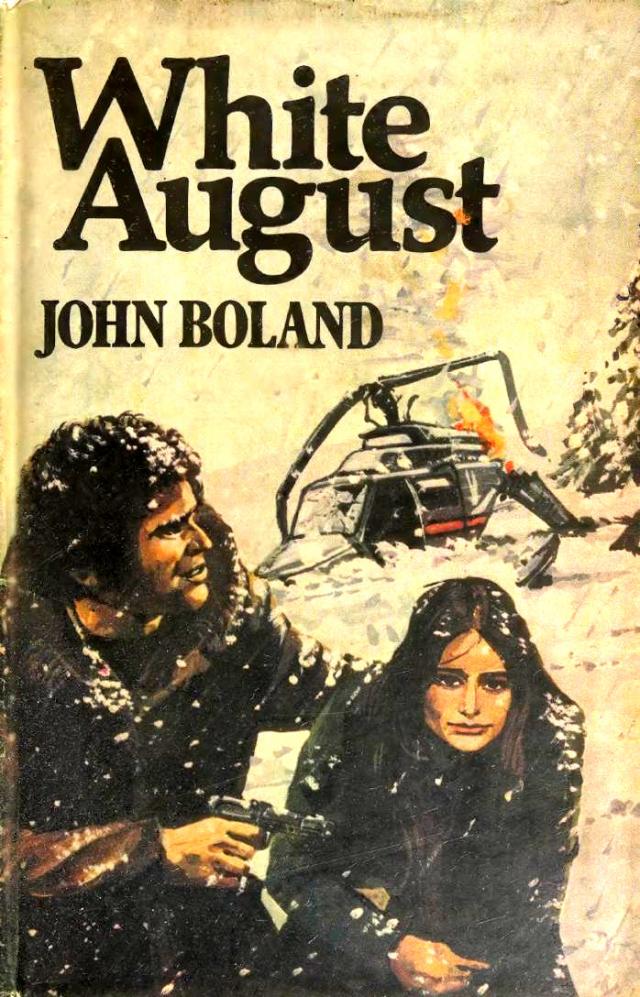
White August
Is it not conceivable that an aggressive power wishing to destroy an enemy would do so by means of subtle, undeclared war, knowing that there could be no fear of reprisals because its guilt could not be traced?
White August deals with such a situation. Without warning, in the middle of a summer heat-wave, snow begins to fall on Britain. It falls relentlessly week after week at the rate of four or five inches a day, until it blankets and all but suffocates the country. What is the Government to do? How are the scientists to combat the menace? What will be the effect on cities, towns, and villages? What will it do to you? To me?
These problems are not impossible ones, for scientists have long been labouring to control the weather, and today’s achievements are not far short of what is described in White August’s Tomorrow. The sense of reality is increased by the style, as if the book had caught the quality of its subject. All is told quietly; but it is the menacing quiet of snow itself. Hunger, fear, terror, nightmare-horror: all these things come to England one white August with the quiet snow, and the triumphant ending brings with it the relief that is felt at the first thaw of spring.
© Copyright John Boland
This Remploy Reprint Edition 1976
Published by Remploy Limited, London
S.B.N. 7066 0684-1
Printed in Great Britain
by J. G. Fenn Ltd., Stoke-on-Trent.
Bound by Remploy Limited
Wind Road, Ystradgynlais,
Swansea, SA9 1AA
WHITE
AUGUST
by JOHN BOLAND
1
At seven o’clock on the evening of My 28th, the sun glared down from a cloudless sky. Over the whole of the Worcestershire countryside its rays were still a burden after a day of almost intolerable heat. On the slopes of the Malvern Hills gangs of weary, sweating men had extinguished the gorse fires, although smoke still rose straight from the ashes in many places.
Three miles to the west of the hills the village of Sturridge was almost without movement; the only man-made sounds a bumble of voices and the clinking of glasses that filtered from the open windows of the Wheel Inn. At a quarter past seven, old Sam Hurrel left his smithy and stumped his way down the dusty village street towards the pub. Sam had done the same walk at the same time for over fifteen years. On his slow way along the street he took stock of the village, his dull eyes taking in everything within their range. The front gardens of the cottages were deserted, doors and windows wide open in an attempt to induce a current of air.
Sam entered the bar-parlour of the Wheel, nodding to the various occupants. ‘Evening, Dan,’ he said.
Daniel Widdowson, the crippled landlord of the inn, had Sam’s pint of bitter ready and waiting.
‘That’s a proper queer-looking sky,’ Sara said. ‘Don’t recall as I’ve ever seed it that colour afore.’
‘Don’t look no different to me,’ Dan replied, staring out through the open window.
’ ’Tain’t over there. It’s in the west.’
Widdowson hobbled from behind the bar. ‘Might as well have a look at it for myself.’ He went outside, followed by two or three of the more curious among the customers. Their excited comments emptied the bar, the others crowding through the door to find out what was going on. In the west the sky was green.
Albert Teal, a farm worker who had served during the war in the Royal Navy, had something to say about the colour. ‘It reminds me of the time I was up in the Arctic,’ he said. ‘We used to get skies like that up there. Green, they was, just like that ’un. Used to be green all night. Not that it ever got really dark at night, not the time of year when I was there. But that’s the colour the sky used to be.’
‘Do you reckon as some of that Arctic cold’s a-coming down to cool us off a bit?’
‘We could do with it.’
Daniel Widdowson stared at the western sky. ‘Looks something like that cream-de-menthy I’ve got on the top shelf, don’t it?’ The unusual spectacle held his attention for another few seconds and then he started to limp back inside. ‘It’s certainly getting cooler.’
‘Well, what do you expect? Sun’s almost gone.’
‘Aye, but it do seem cooler than it’s been for the last few nights.’
Sam Hurrel was waiting, his glass empty.
‘What did I tell you! I ain’t never seed that colour sky afore.’
‘Somebody blowed up one of them atom bombs, I shouldn’t wonder,’ Daniel offered. ‘Dust clouds, that’s what it is. Something to do with the way the sunlight shines through the bits of dust. I read about it once. Some volcano that blowed a whole island to Kingdom Come. Terrible calamity it was. A lot of dust was floating round in the sky for years and there was all sorts of queer colours. Went on for three or four years, it did.’
‘Reckon as they’ll tell us on the nine o’clock news, if that’s the case,’ Sam said. ‘There’s too many of them things being blowed up nowadays.’
During the next half-hour the unusual colour spread east* wards across the sky, and as the light failed it became much cooler, the temperature dropping rapidly, affording relief from the heat for the first time in two weeks. By eight o’clock the whole evening sky was green. At nine o’clock it began to snow.
The Wheel was crowded when the first fine flakes began to drift down from the darkening sky. The flakes melted even as they fell, the survivors vanishing as they touched the still-warm earth. But, without doubt, it was snowing.
William Barnaby Garrett, Doctor of Science, was walking to the Wheel Inn from his home a mile outside the village. One of the foremost scientists in the country, head of the Farncroft Experimental Establishment at Malvern, the Doctor was a man of simple tastes. Two or three pints of beer in the evening, and a pipe of tobacco, satisfied him. A tall, thin, bald man in early middle-age, he was a widower. Ten years earlier his wife had been drowned in a boating accident in the first week of their marriage. This evening as he was walking along, he was contemplating the idea of getting married again. The girl was his secretary, Mary Gilholland, whose home was in Sturridge.
As he walked, Garrett kept turning his face upwards, enjoying the abnormal effect in the sky. Just as he reached the outskirts of the village an ice-cold spot of water fell on to his forehead. He stopped, and as he stood there looking up another spot of icy water hit his cheek. He stretched out his hand and saw with deep interest a small, circular snowflake fall on to his palm. The flake melted immediately, but within a minute he saw half a dozen more. They seemed to be all the same size—approximately as big as a grain of rice.
He turned the last bend and came within sight of the pub. Everyone in the village was out in the street, staring up at the sky and excitedly calling out to one another as more of the flakes came down. Among the din and excitement he was unnoticed for a moment. Then the villagers saw him and they crowded round, eager voices hailing him from every direction.
‘What do you make of it, sir?’
The people clustered round him, bringing him to a halt. ‘Proper old English summer, ain’t it, eh, Doctor? Sun a-burning everything to dust one minnit; next minnit it’s a-snowing.’ There was a burst of laughter. But Sam Hurrel’s question reflected the anxiety felt by some of the older people.
‘ Tain’t natural, is it, sir?’ he asked uneasily. ‘Do you reckon as there’s suthin’ gone wrong somewheres?’
Garrett smiled. ‘I don’t think so. At a guess, I’d say it’s the result of high-flying aircraft causing condensation. That’s only a guess, mind you.’
‘But there ain’t been nothing flying round here this evening, sir.’
‘Maybe the planes were so high that you couldn’t see them or hear them, either.’
‘There worn’t none of them vapour trails.’
‘And even if there was aircraft up there, they couldn’t have changed the colour of the sky to the way it’s been this evening.’
The scientist smiled again. ‘Well, then it’s probably just what you said it was: English summer weather!’
The crowd laughed, the small sally easing the momentary tension. The people started to drift apart, most of the men going back inside the Wheel, and the women hurrying indoors. But Sam Hurrel and Albert Teal lingered in the doorway of the pub to watch the still falling flakes. The two big men stood close together, each conscious of the other’s uneasiness.
‘ Tain’t natural,’ Hurrel muttered stubbornly. ‘ ’Tis all very well for them fools to laugh, but I could see as the Doctor didn’t like it no more’n do I.’
‘Aye. ’Tis a queer business, Sam, and that’s a fact. I’ve been in a good many places, and I’ve seen a-plenty of queer sights, but I never did see one to cap this ’un.’
The street was almost deserted again. One or two women stood talking quietly at the gates of their gardens, but most of them had gone indoors. A thought occurred to Albert Teal. ‘I wonder if this is just local?’
Teal’s question was answered by the B.B.C. in their late news bulletin. At the end of the news, the announcer, in lighthearted mood, said: ‘During the past two or three hours, many hundreds of listeners have reported to the B.B.C. that snow is falling. These reports have been sent in from all over England, Scotland, Wales, and Northern Ireland.’ He paused. ‘Er—the weather forecast for tomorrow is that the present heat-wave will continue.’
All through the night the peculiar sky effects continued. Strong lunar rainbows were visible from most areas, while in northern Scotla
The morning news broadcast from the B.B.C. was very different in manner from the previous day’s. There was nothing light-hearted in the announcer’s tone. Very soberly he gave details of the freak weather conditions. Snow was reported to be falling over the whole of the British Isles; the mean temperature was more than thirty degrees cooler than the day before. From the Shetlands to the Scillies, it was the same story. A dead calm prevailed, under skies coloured a dark green.
Shortly after the news broadcast began, Charles Henry Warburton, Prime Minister of Great Britain, switched off the radio and strode into the garden of his Kentish home. Slow-moving, almost clumsy, he looked like a prize-fighter run to flesh. Small brown eyes set in a round face that was topped by a shining bald pate, he was no beauty. But his voice and gift of oratory were the envy of every actor and politician speaking the same tongue.
Warburton ambled round the edge of the lawn, twisting his head from time to time to look up at the sky. He stood and watched a few flakes come down. They disappeared as they hit the wet earth, and he remained staring at the place where they had vanished. Suddenly he made up his mind and went back to the house. For the next half-hour he kept his private secretary busy putting through various telephone calls. Three hours later, as a result of the answers to the phone calls, the Prime Minister was on his way to No. 10 Downing Street.
On Sunday, July 30th, at eleven o’clock, Warburton faced four men in the small committee-room at the rear of No. 10. Clare, the neat, precise, acid-tongued Minister of War; Mall art, one-eyed, trim-bearded Foreign Secretary;
Timothy, a huge bull of a man, who was Defence Minister; and the fussy, close-mouthed leader of the Opposition, William Gregson. Warburton ushered them to seats at an oval table near the window, then slumped into a chair.
‘I am sorry that 1 had to call you here,’ he said, ‘but I have news to impart, news of the utmost gravity.’ He stared for a moment at the expectant faces. ‘News of such terrible import that I hesitate to inform you. Gentlemen, I have to inform you that this country—that Great Britain—is at war!’
He raised a hand to quell the shocked outburst of questions. ‘No, I am not mad. Far from it. Look for yourselves; look there.’ He pointed to the window that overlooked the walled garden at the back of the house. ‘There is the evidence; you can see it with your own eyes.’
The men watched in silence as two or three small flakes drifted down outside the window. Warburton’s face was grim. ‘Do you, gentlemen, do you for one moment believe that that snow is natural? That it is brought about by some natural means, through some freak weather condition?’ He paused. ‘I tell you, in all solemnity, that it is brought about by one of our enemies; by one of the Queen’s enemies!’
Mallart ventured a question. ‘But, Prime Minister, is it possible?’
Timothy answered the question. ‘It’s possible, certainly. The Americans were the first to produce artificial rain and snow. It was a matter of some importance to them because of the large areas of the United States that suffered from drought. Although we haven’t any need of it in this country, we have tried the technique, purely as an experiment. It was only on a small scale, of course. I was there when we did it. In Buckinghamshire it was, a couple of winters back. There was a measurable fall of snow after an aeroplane had seeded the clouds with pellets of some chemical or other. Carbon dioxide, I believe it was.’
Clare snorted. ‘What we did was, as you say, on a small scale, a very small scale. And in order to produce even that bit of snow we had to do it in winter, with suitable cloud conditions.’ He smiled bleakly at Warburton. ‘Er—precisely what are your reasons for making such a startling announcement, Prime Minister? On what evidence do you state that we are at war? And don’t you think it might be as well if you told us the name of the enemy with whom we are at war?’
The Prime Minister chuckled. He was almost genial as he prepared to deal with the Minister. ‘You have put more than one question, Clare. So I will be generous in my turn, and give you more than one answer. When I have given them, maybe you will agree with me. Here are some fac*s. Fact number one: it is somewhat singular for snow to be falling at this time of the year. Even in this country. In the one hundred and fifty-six years that records have been kept, there is no report of snow falling in July. Fact number two: the rate of fall is exactly uniform throughout the whole of the British Isles. There is no measurable variation.
‘And now for fact number three, which is, without doubt, the most significant of all. The area of precipitation is almost completely rectangular in shape. From the north-east tip of the Scottish coast, to the tip of North Foreland, the snow ceases approximately thirty miles out to sea. But at Dover the snow extends only ten miles out from the shore. But at Hastings the distance is again thirty miles. Do you see the significance of this? The overlap from the coast is less at Dover. Therefore, not one flake of snow has, so far, fallen on the Continent.’
‘It very often rains in Dover when it’s fine on the French coast on the opposite side of the Channel,* Clare said.
‘Oh, quite,’ Warburton agreed smoothly. ‘But the facts I have given you must make any man with brains suspect that there is more to it than freak weather. No, gentlemen, I am positive we cannot escape from the conclusion that the snowfall is being directed by an intelligence. It is far, far too methodical for it to be happening by chance.’
Mallart shifted uneasily in his seat. He was about to say something, when Clare spoke again.
‘Er—you haven’t named this enemy, Prime Minister,’ he said, his voice smoother than usual.
Warburton nodded. ‘I wondered how long it would take you to harp back to that fact, Clare. Well, I’m afraid that’s one answer you are not going to get. Personally, I don’t believe I have to. Is there any doubt in your minds as to the nation responsible? But until we have proof, I suggest it would be wiser to keep our thoughts to ourselves. It would do more harm than good.*
‘But what can we do?’
‘We can’t do anything, Mallart. Unless we can find the source of the trouble, there is nothing we can do.’ He looked at each man in turn. ‘Gentlemen, this soft, white, innocent symbol of purity may prove to be a weapon more powerful, more terrible, more potent in its destruction than anything we have had to endure in all our long history. It might well be that this weapon could outstrip the horror of what, for want of a better term, I call a conventional atomic attack. Let us assume for a moment that the temperature drops below freezing-point. Once that has happened, the snow will begin to settle. If the snow continues to fall for long enough, then almost every spark of life in these islands will be extinguished. We shall be suffocated—suffocated by a white blanket that will increase in weight and thickness hour by hour, day by day, until there is no life strong enough to exist under it.’
‘That could happen, Prime Minister, but will it?’ the leader of the Opposition said. ‘The snow might stop at any moment.’
‘It may stop. But it may not! And for the sake of the country’s safety, we must assume that the snow will continue. At the moment, the fall is very slight. But what will happen when the weather conditions are more favourable for snow? The fall may become very rapid indeed.’
Timothy slammed a huge hand on the table. ‘You’re right, Prime Minister, absolutely right. We’ve got to be prepared for whatever may happen. If it gets worse …’
‘If it does, we are doomed. First we should lose the harvest; then travel would become increasingly difficult, until it reached a stage where we should not be able to move supplies of food and fuel. Millions of our people would either starve or freeze to death.’
‘They could be evacuated.’
‘Impossible! Where could we send them, even supposing we had sufficient shipping to do the job? What guarantee that the other countries in the Commonwealth will not themselves be attacked?’