Space search v1, p.1
Space Search (v1.)), page 1


“Disappeared?”
“Yes. We cannot raise him on his interplanetary transceiver and the Medean authorities cannot find him. They have concluded that he has met with foul play. At whose hands they cannot discover.”
“But … but don’t we have an embassy on that world?”
Mulk Jhabvola nodded. “A small one. They have been able to discover nothing. He is presumed dead.”
Venu stared at his uncle. In spite of the other’s efforts to look sympathetic, the satisfaction showed through.
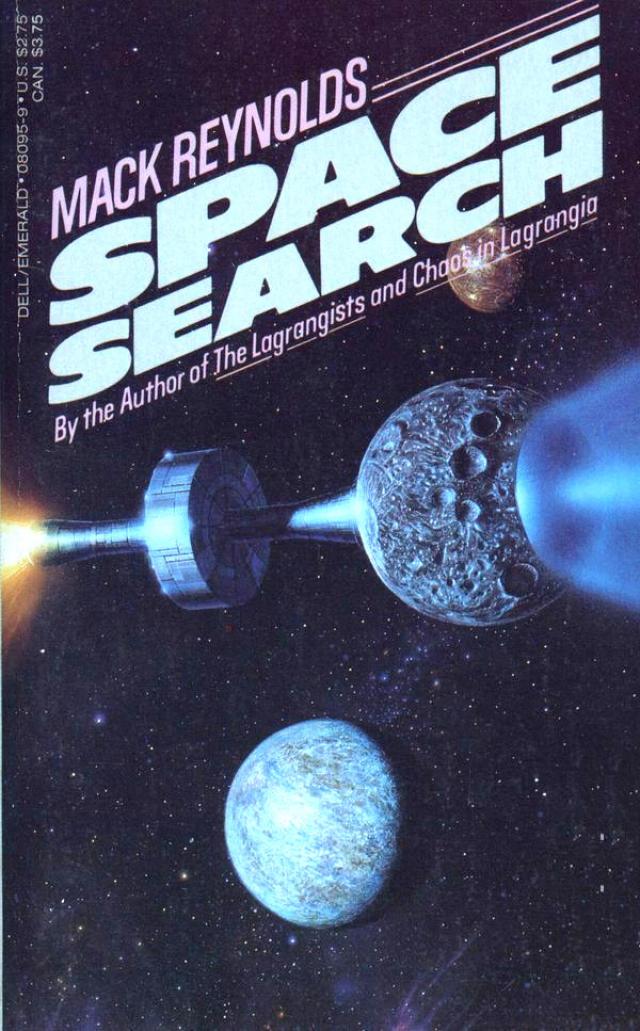
SPACE
SEARCH
MACK REYNOLDS
SPACE
SEARCH
DELL / EMERALD
Published by Dell Publishing Co.. Inc.
I Dag Hammarskjold Plaza
New York. New York 10017
Copyright © 1984 by Mack Reynolds
All rights reserved. No pan of this book may be reproduced transmitted in any form or by any means, electronic or mechanical, including photocopying, recording or by any information storage and retrieval system, without the written permission of the Publisher, except where permitted by law.
Dell ® TM 681510. Dell Publishing Co., Inc.
ISBN: 0-440-08095-9
Printed in the United States of America
First printing—November 1984
Space Search
1
Perhaps Venu Jhabvola would have hesitated if he had been able to foresee the developments that would follow his departure from Harappa, the planet of his birth, to search for his father.
Venu had been surprised when, shortly before his 17th birthday, he was summoned to the presence of Khushwant Narayan, Guru of the University of New Bombay. He had never met the Brahman and had never expected to. As a member of the Vaishyas, he was fortunate enough to attend the upper caste school. He knew it was a concession to the high regard held for the sub-caste his father headed, that of the Expediters. It was widely believed that when and if there was an opening in the fifty families of Kshatriyas who ruled his world that the Expediters might well be picked to be raised to that degree, an event that had not taken place in Harappan history for more than a century.
He was accompanied by his sister, Santha, who was a year younger than Venu and a freshman. She had changed from student garb to a formal sari of green and gold, and had, for the unprecedented occasion, dabbed her forehead with a crimson caste mark. Venu himself had carefully bathed in the holy pool of the Mandar Temple, and wore a formal achkan—a high-necked, tunic—over jodhpur breeches.
Santha was as bewildered by the summons as was he. They conferred briefly before heading for the university administration building, which was a replica of the Lakshmi Narayan Hindu Temple back on Earth from which their own planet had been settled centuries ago.
But neither could contribute anything. They had been simply instructed to repair to the offices of the guru.
Santha demurely following, as befitted a girl walking with her elder brother, they set out down the long, pool-flanked path to the garden-surrounded building of administration.
At the portal, with its lotus bundle columns and scalloped arches, rich with arabesques, they were met by a secretary, who gave them no more than greetings and led the way to the inner private office of Guru Khushwant Narayan.
They entered, side by side, and the secretary bowed slightly and withdrew, closing the door behind him.
Venu had often seen the university’s guru on Tri-Di television but had never been this close before. The other, being a Brahman, was lighter of skin than either of the two students, and was seated behind a desk, the sacred thread of the Brahmans over one shoulder and the mark of Vishnu, The Preserver, chalked on his forehead, rising from the bridge of his nose like two thin white horns.
Both Venu and Santha blinked when they recognized their uncle, Mulk Jhabvola, seated next to the desk. His face was even tighter than usual but there was something else in his expression that Venu couldn’t put his finger on. There was no love between them, the two students knowing full well that the heavy-set merchant resented the fact that Sudhin Jhabvola, their father, was rishi of the Expediters, rather than he. Mulk Jhabvola was above all ambitious, and from his youth his older brother had thwarted him.
Both Venu and Santha put their palms together and slightly out from their chests, bowed to the guru and said, in unison, “Namastey,” and then turned to Mulk Jhabvola and repeated the Hindu universal formal greeting.
The guru, a handsome man in his middle years and, as a Brahman, with his Aryan heritage, somewhat taller than either Venu or Mulk, nodded to the newcomers, his face very serious.
“Be seated, my children,” he said gently. “I am distressed that the occasion is one of bad tidings.”
Venu froze slightly before taking the proffered chair. It could only be about his parent, who was off on a space expedition to another planet.
The guru said gently, “It is indicated that Rishi Sudhin Jhabvola, your father, has met disaster in the service of Harappa.”
“Disaster!” Santha blurted. The three males ignored her. It was unseemly for a girl to speak .in the presence of men without being directly addressed.
The guru turned to Mulk Jhabvola. “As the young people’s uncle and acting rishi of your sub-caste, perhaps it would be best if you gave Venu and Santha the details.”
The merchant’s voice was unctuous. He said, “As you possibly know, your father, in his role as an Expediter, had journeyed to the planet Medea to arrange for an exchange of their uranium to the planet Basque in return for electronic equipment, so that the Basques in turn could trade the uranium to us, in return for star sapphires and other gems. Basque did not need the uranium itself, but had nothing, otherwise, of interest to us to trade. It was, in short, a three-way arrangement.”
“But, uncle,” Venu said, “what happened to father? Was it an accident in space? Did something happen to the spacecraft?”
The other shook his head. “No. He arrived safely on Medea. He even began the transactions, in competition with other interests also desiring the uranium trade. But suddenly he disappeared.”
“Disappeared?”
“Yes. We cannot raise him on his interplanetary transceiver and the Medean authorities cannot find him. They have concluded that he has met with foul play. At whose hands they cannot discover.”
“But … but don’t we have an embassy on that world?”
Mulk Jhabvola nodded. “A small one. They have been able to discover nothing. He is presumed dead.”
Venu stared at his uncle. In spite of the other’s efforts to look sympathetic, the satisfaction showed through.
And why shouldn’t it? It would be eight years before Venu would be of age. Eight years in which Mulk Jhabvola would be acting rishi of the family and of the Expediters’ sub-caste. That would most certainly be sufficient time for him to entrench himself in the office to the point that even when Venu was of full manhood—twenty-five—he would never succeed to his father’s rank. Competition for positions of power was strong on Harappa and ambitious men such as his uncle would resort to almost anything to dominate as potent a sub-caste as the Expediters, particularly in view of the fact that it was seemingly only a matter of time before the Vaishya sub-caste was raised to the Kshatriya caste, which exercised control of the government.
Venu said quickly, “I must go to Medea to find my father.”
Santha said, “Yes!”
His uncle didn’t bother to hide his impatience. He said, “Don’t be ridiculous. You are but a lad, and besides, both our embassy and the Medean authorities have done their utmost to find Sudhin and have failed. He has disappeared completely. They cannot even get a cross on his transceiver with their communications computers. It has obviously been destroyed.”
Venu was on his feet, his face and voice urgent. “I must go!”
Mulk Jhabvola said sternly. “As acting rishi of the Jhabvola family, I forbid you to further consider the matter. It is out of the question and you are being most unseemly.”
The guru frowned slightly, but said nothing. Even though he was a Brahman, he did not feel it seemly to intervene. He could, of course, have overruled the lower-caste man, but in actuality he himself thought the desire of Venu unreasonable. He felt for the young man, but what was there to do?
The guru said, “Undoubtedly, my children, you will wish to return to your family estate for the ceremonies. I give you permission to take leave of the university for the required period.”
Mulk Jhabvola said thoughtfully, “Perhaps not to return. I have never thought much of higher education for women, and as for you, Venu, I am not sure you are cut out for the scholarly life. Perhaps it would be more realistic for you to go immediately into the family business and learn expediting.”
Venu was shocked. “But if I am one day to become rishi of the sub-caste, as my father before me, it is necessary that I have university schooling.”
“I shall consider the matter further, following the funeral ceremonies,” his uncle said condescendingly.
2
Venu and Santha, returning to their small bungalow in one of the student compounds, were aghast.
Santha said, “But what has Uncle Mulk in mind, brother? Surely you must attend the university. Already you have taken honors for three years and you are still but seventeen. As you told him, if ever you are to take the position of rishi, you must be the best educated male of our family.”
Venu said bitterly, “If I am compelled to go down from the university, I have no doubt that shortly Uncle Mulk will make arrangements for our cousin, Bharata, to attend in our place. Bharata is brilliant enough and the son of his father. He would take every measure to secure enough prestige that when the family elders voted upon the new rishi, I would be deemed inadequate to take over father’s position, but Bharata would be found to hold the qualifications. Undoubtedly, he would be but a figurehead for Uncle Mulk for years to come.”
“But Uncle Mulk is father’s own brother!”
He could see she had little knowledge of the men’s world of angling for power, wealth, and prestige. But then, as a girl, she had no need to have. In due time, a suitable husband would be found for her through family dickerings with acceptable other families of their same caste level who had bachelor sons. A suitable dowry would be paid, and Santha would move to her new home to take up the tasks of womanhood. So were the traditions brought from Mother India, long centuries past, and still followed on this far world, on the rim of the sun systems settled by Earthlings.
“Yes,” he said emptily, “Uncle Mulk is father’s brother.” He didn’t bother to mention the considerable difference between the two men.
They reached the compound and made their way through the garden walks to their own bungalow, which they shared. A girl, even though a student at the New Bombay University, the most preeminent on Harappa, could not be expected to live alone, without supervision on the part of at least one male member of her family.
To their surprise, when they entered, they found their two closest friends, the Gupta twins, Attia and Kamala, son and daughter of Chandra Gupta, most high in the politics of this province and of Harappa.
Kamala, sari clad as was Santha, but with the caste mark of the Kshatriyas on her forehead, came quickly to her feet from the divan upon which the two had been seated and hurried, with Indian grace, to take Santha in her arms.
Attia stood too. He was dressed as Venu, in achkan and jodhpurs. Obviously, the two of them had attired themselves for a formal occasion.
Attia put the palms of his hands together and bowed slightly to Venu and then to Santha. He said, expressionlessly, “Namastey, friends Venu and Santha. And … and condolences.”
Venu returned the greeting. It was the first time in their years of relationship that his friend had ever saluted him in formality.
He said, “Then you have heard the news of our parent?”
Attia nodded, looking infinitely pained. “My father revealed the matter this morning.”
Santha was weeping silently onto Kamala’s shoulder.
The twins were Venu’s age. They were intelligent of face, handsome of features. If it hadn’t been for the fact that Kamala was of higher caste and hence beyond him, Venu would have urged his father to begin the lengthy negotiations to make the girl his bride. But that, of course, could not be.
Venu said, “Please be seated, our good friends. It is typical of you to come to share our grief. Can I offer you a sherbet?”
Kamala seated herself next to Santha, her arm still around the other. Attia returned to his divan seat, less formal now.
He said, “We shall be present at the ceremonies, of course. Then, I assume, after a decent period of mourning, you will return to us here at the university.”
Venu shook his head. “My Uncle Mulk is now acting rishi of our family, and, indeed, as such, acting rishi of the Expediters subcaste. His desires are our commands. Right before the guru, he informed us that he did not believe in higher education for women and that he didn’t think me suitable for the scholarly life.”
Kamala said, “But what do you mean, Venu? That is ridiculous.”
“Please,” Venu said, “You speak of my uncle and the acting head of my family.”
Attia bit out, “He is trying to seize the position which is rightfully to be yours!”
Santha shook her head and said softly, “Venu wished to journey to this planet Medea and see if he could find trace of father, but Uncle Mulk forbade him.”
“Why?” Attia snapped.
Venu looked at him. “He said I was but a lad.”
His friend came to his feet and paced the floor in mounting anger. “Yes, but a lad. However, if you were successful in the quest, your uncle would again be removed to a position of lesser honors. It is obvious that he does not wish your father to be found.”
“Please,” Venu said, as an honorable young man must, “you should not speak in my presence against the brother of my father. It is not seemly. Besides, the local authorities on Medea have been able to find no trace of Sudhin Jhabvola and he is presumed dead.”
Attia’s anger was growing. “Do not chide me, Venu Jhabvola. Pray remember that I am a Kshatriya and you but a Vaishya. Now come with me.” He turned to the two girls. “We go to confer with my father, Gaewar of the Kshatriya caste of New Bombay.”
Venu Jhabvola, aghast at his friend, protested all the way to the palace. However, Attia was having none of it. They took one of the new anti-gravity, automated rickshaws and Venu’s upper-caste friend dialed their destination. It was one of the few times Venu had ever ridden on one of the ultramodern means of local transportation, in spite of the fact that his father had expedited its import into Harappa from the planet Techno. There had been murmur-ings at the time, from the more traditional. Harappan elders, in particular, did not take kindly to new innovations. They had originally fled to this world to escape the break with hoary leftovers from yesteryear on Earth, and dragged their feet at each advance here on Harappa.
They entered the Gaewar’s palace through a monstrous gate that reared itself a full hundred feet into the air, and then proceeded to the Keep.
They dismounted from their vehicle and ascended the stairs of the platform on which the inner palace was constructed. Upon their approach, two Sikh guards sprang to the salute, their ceremonial swords across their right shoulders. They were taller than the two students and burlier—professional soldiers and guards for twenty centuries and more. They wore the traditional thick beards, caught up in a little net, and orange turbans about their heads. Venu knew that by their religious laws, somewhat different from the Hindu, they never shaved nor cut their hair, and it was deemed a great insult for them ever to be seen, by other than their immediate family, with their turbans off. They were also supposed to wear a wooden comb in their hair, an iron bangle on a wrist, and to carry an iron-handled knife. All of these customs went far back into the mists of antiquity.
Attia didn’t bother to acknowledge the salute in any manner, but led the way on into the Keep. Venu had on occasion visited the Gupta twins in their home, here in the palace grounds, but that had been the family quarters, never the Keep where the official business of New Bombay province was conducted. On the outside, it seemed a medieval Indian construction, but deep beneath the planet were extensive offices, long halls, and chambers, complete with computers, data files, and the rest of the automated-computerized equipment of modem technology. Harappa seemed old only on the surface.
They halted, finally, in a large, magnificently done reception room, well packed with those soliciting the attention of the powerful man within. A secretary scurried up to them. He greeted Attia with palms together, as though praying, and the usual “Namastey” greeting as he bobbed bows. After all, Attia was the only son of the Gaewar and might well one day take his father’s place as one of the most influential men on Harappa.
Attia said curtly, “Is my father free?” Although he was of the ruling caste himself, he disliked overly subservient underlings. It was a sign of his being one of the up-and-coming generation that he had chosen Venu, of a lower caste, to become his best friend. Attia Gupta was no class snob.
The other bowed slightly again. “He is in conference, but should be free very shortly. It is to be assumed that it is a matter of importance?”
Attia looked at him. “Do you imagine I would intrude upon the Gaewar, while he is holding audiences, if it were otherwise?”