

Her fathers daughter, p.1
Her Father’s Daughter, page 1
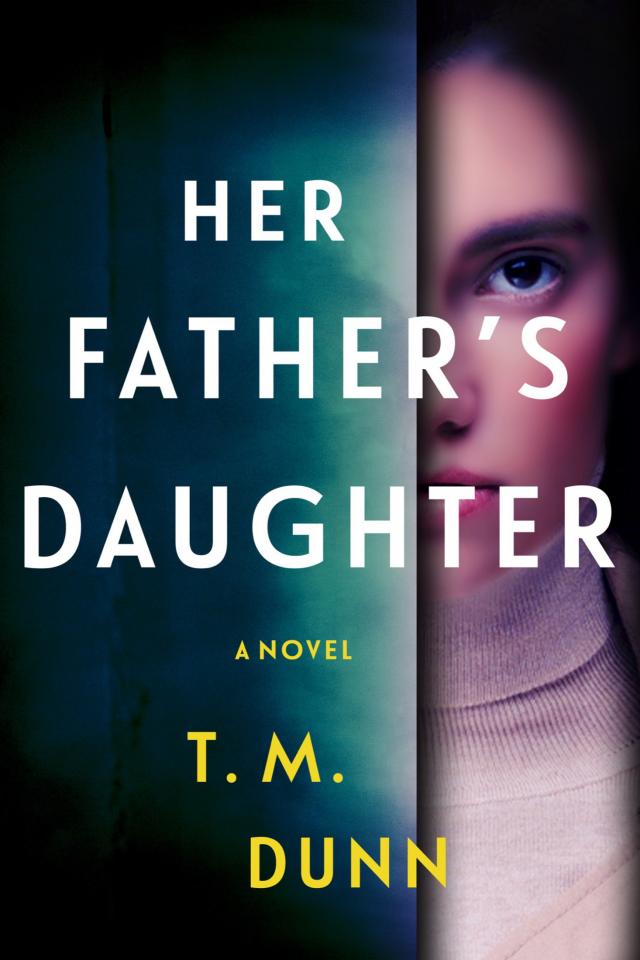


HER FATHER’S DAUGHTER
A THRILLER
T. M. DUNN
To Allan, my partner in life, who makes it all possible
I cannot think of any need in childhood as strong as the need for a father’s protection.
—Sigmund Freud
PROLOGUE
“DON’T YOU LIKE it?” Mother asked. “Your father spent all night putting it together, one hundred and two pieces.”
I found the model train circling our Christmas tree—the kind not for playing but for collecting—tedious and redundant. Around and around and around. I didn’t want to disappoint them. It’s a beauty, I remembered the father on the commercial saying to the son. This is the best present ever! the son replied.
“This is the best present ever!” I jumped up and down with pretend glee, flashing a smile so wide it hurt. My father patted the top of my head, picked up the engine, slammed me in the face, and broke my nose.
“You have potential for greatness,” Father told me on the drive home from the emergency room. “Acting is an art. The difference between a great actor and a good liar is commitment and sacrifice.”
The pain medication had me in a semiconscious state, but I would never forget the two greatest gifts I’d ever receive: the inspiration to act, and though not as monumental but nevertheless life changing, a broken nose, which the doctor reset to be perfectly straight, an essential feature for an actor.
I would never develop an interest in model trains, but the one that circled our tree on Christmas morning the year I turned six was the reason I wanted to become an actor, a great one.
Which was also why, the first time Sal punched my ticket on the Metro-North New Haven Line, from Hartford to Grand Central, I knew he was the one.
Sal’s side-to-side shuffle, his regional accent, which incrementally changed as we approached New York, the way he tipped his cap back each and every time he said, “Tickets, please,” and the way he tipped it forward every time someone asked him a question about the time or the location of the nearest restroom—all made it abundantly clear that Sal, the Metro-North train conductor, would be the next character I studied, rehearsed, and became.
LINDA
CHAPTER
1
THE SMELL OF burnt eggs and sweet peppers woke me at 7:25 AM.
I didn’t run. I walked to the kitchen. Flames shot up from the cast-iron skillet. I sighed and poured out the box of salt, kept close to the back burner for exactly this purpose. For the third time this month, the apartment building was saved from ruin and breakfast was charred to an inedible crisp. With one of our checkered, singed potholders, I grabbed the handle and dropped the frying pan into the sink.
Where the hell is he?
Dad might forget to shut off the stove before he left the apartment, but he never went anywhere before he had his coffee. I picked up the Greatest Dad mug, the only one my father ever used. The inside was clean. I turned it around and around, searching for answers, but there were no fortunes to be read in his empty cup.
He had to be home.
Could he still be sleeping? Dad never slept past seven AM. I thought maybe he wasn’t feeling well again. Over the last few weeks, he’d been complaining of headaches and stomach issues. He blamed my cooking, but I knew something else wasn’t right. He refused to see a doctor, because there was nothing bottles of Pepto-Bismol and handfuls of Advil couldn’t fix.
I had managed to get one of our customers, a primary care doctor, to look him over when we exterminated her apartment for silverfish. She said that without tests she couldn’t say for sure, but she asked if he was feeling stressed. He shook his head no, and I almost lost it. Dad was always worried about something. The something usually related to me.
His latest concern was that I, his reason for living, would be off to college in a few weeks. He pretended to be happy for me, but I knew he wasn’t. I was all he had in the world.
What was I supposed to do? Instead of going to college after high school, I’d helped Dad run his business for the past seven years. If a full scholarship hadn’t fallen in my lap, I probably would have put my life on hold for another seven years. The only out-of-state school I’d applied to was in California, a long shot, but they’d offered me a full ride. Dad agreed it was an opportunity of a lifetime and I couldn’t turn it down.
But now I was worried. How would he survive without me? I had been his entire life since my mother died.
Ah, that was it. Today was August 2. I couldn’t believe I had forgotten, but I was grateful I had.
I walked to his room, tugging on my right earlobe, which was shorter than the left. Dad called this idiosyncrasy my “tell,” a nervous tic that showed I was worried.
I banged hard on Dad’s bedroom door, waiting for him to open, but when he didn’t, fear scratched the back of my throat. I was sure he was fine, but what if …?
I touched my earlobe, turned the knob, and went inside. “Thank God,” I said.
Dad sat on the edge of his bed in his usual discombobulated state. His mismatched pajamas and worn socks (retrieved three times from the trash) made me sad. As did his half-in/half-out ponytail that I swore I would cut off some night while he slept.
He was good-looking, sweet, but too shy ever to show his teeth when he smiled. Dad had no interest in dating. “You’re the only person I need,” was how he deflected it. At five, ten, even fifteen years old, I found this comforting. At twenty-five, I was suffocating. Two weeks from tomorrow, I’d be off to California for my freshman orientation at USC, and I refused to feel guilty for leaving Dad, but it pinched the back of my eyeballs to see him sitting with the photo album he retrieved from the back of his closet every year on the anniversary of Mom’s death. Thirty-six pages filled with happy pictures of my parents from the time before I was born.
Dad obsessed over only one photo, a Polaroid of Mom with clay-speckled hair and a belly protruding from under a white T-shirt too small for her preggo bod. Dad had snapped the photo the day she finished what he thought was her best work: a three-foot sculpture of our family—Mom, Dad, and their imagined baby. The piece was still stationed between his bed and dresser, the epicenter of the room, under a spotlight angled at thirty degrees, the best position to see the details.
All I ever saw was an orange blob of clay. A dust collector.
Dad said my mother was a great artist. Maybe she was. I didn’t know a lot about art, and I had never known my mother. She killed herself three days after I was born.
“Fire,” I said, and he looked up from the album. “Breakfast is burnt.”
He didn’t react as expected. No apologies. No running to the kitchen to try to save what was already too late to be saved. Instead, he patted his bed for me to take a seat next to him.
We had no time to go down memory lane—his lane, his memories. We had a job to do. One of the luxury buildings we serviced on Park Avenue had mice. People, especially those of means, lose their shit at the mere mention of a mouse sighting. But the fact is, if you live in NYC, you’ll have mice. Unless you have a good exterminator.
Donovan and Daughter Exterminating was the best. We were a small, family-run business and took care of any and all situations with a personal touch. Our customers weren’t digits in a spreadsheet; they were people who depended on us to make their problems go away.
“Credo,” I said. “We have to get to work.”
“Forget Credo.” Dad patted the bed again.
Michael Credo was the building manager of all the Park Avenue buildings we serviced. He was a pompous ass, but he had the power to hire and fire contractors like us. His buildings brought in half our income.
“Please,” I said.
“Not today.” Dad patted the bed again.
I knew arguing would get me nowhere. I sat.
Dad opened his nightstand drawer, stuffed with the laminated wallet-sized cards he collected at funerals.
Whenever someone died in the neighborhood, whether we knew them or not, we were there. While some fathers took their children to parks or to Dairy Queen for ice cream or ignored them altogether, my father took me to funeral parlors. I’d seen more dead bodies before the age of five than episodes of Sesame Street and Barney combined.
Dad palmed a card in each hand. “Right or left?”
Oh lord. Each card had a picture of a saint on one side. On the flip side was the name of the dearly departed along with a special prayer, and often the name and address of the funeral home.
I pinched my lips. I wanted to eat. “Breakfast,” I said.
“Right or left,” he repeated.
Dad never raised his voice. When he was upset, he whispered, and when he was furious, he didn’t say a word. Dad had given me the silent treatment only twice. The first time I was so young that I can’t currently remember why, and the second time was when I’d sent him a text, intended for a friend, in which I noted that it’d been five weeks since my last cigarette. Dad had asked me a week before if I smoked, and I’d told him, “Not once.”
Dad shoved the cards under my nose. “Pick one.” He acted as if I had a choice, but there was only one answer that would satisfy him.
I sighed and pointed. “Right.”
Dad revealed St. Raphael, the patron saint of soul mates and happy times, on the front; on the flip side, the name of the dearly departed, Rebecca Charlotte Donovan—died August 2, twenty-five years ago today.
My mother.
The details of that day had been branded into my memory as if I had been the
It was overcast, but so humid you sweated in the shower, when my mother went to the NICU unit to say good-bye to her daughter, born nine weeks too soon, weighing one ounce under two pounds, fighting for her life inside the plastic walls of an incubator.
I knew how my mother had died—an overdose; she swallowed the whole bottle, save for three pills. Whenever I asked why she’d committed suicide, Dad would only say, “The weight of her love was more than she could bear.”
In middle school, the snarky teen in me added to the story: “Three pills, one for the father, the daughter, and the mother.” A joke that was not well received, as Dad didn’t simply love my mother—he worshipped her. I wanted nothing more than to forget this story and the woman who’d abandoned us, but as long as my father lived, that would be impossible.
I glimpsed a tear in the corner of Dad’s right eye, and I decided I wouldn’t play the part of the grieving daughter. Crying was a luxury we couldn’t afford, especially not today, with our biggest customer scheduled for service.
“I love you,” I whispered. “She’s gone, Dad. Let her go, please.”
“Never.”
That was it. I’d had enough. I tore my mother’s death card straight down its worn laminated center, one half for Dad and the other half for the wastebasket at his bedside. I didn’t want to hurt my father, but he’d wasted years of his life pining over a woman who’d abandoned both of us. It was time for him to move on. I left him and went to the kitchen.
I gulped down a strong cup of coffee, spitting the coffee grounds that had slipped through the filter into Dad’s empty mug.
Before I could make Dad a coffee to go, he was standing in front of me, dressed, with his ponytail pulled back and neat. At least it wasn’t a man-bun.
“Thank you,” I said.
Dad glanced over at the burnt pan in the sink. “What was it?” I asked.
“Your favorite,” he said.
Dad kissed my forehead, and I smiled, relieved he wouldn’t spend the day reenacting his annual wallow-fest but instead would go to work with me. I walked to the apartment door, grabbing the set of keys attached to the dyed-blue rabbit’s foot Dad had owned since he was a kid, and grasped the doorknob. Then I stopped. I heard her on the other side of the door and froze, keys in one hand, doorknob in the other, sucking down my breath.
Dad didn’t ask me what the holdup was or why I was no longer in a rush to get to Credo, the account we couldn’t afford to lose. Now we both heard our neighbor Mrs. Camberi’s health aide fumbling with her keys in the hall. I had managed to avoid Anne since the night we’d slept together, and there was no way I was going to face her now in front of my father.
I waited until I heard Mrs. Camberi’s heavy metal door slam shut before I opened our door to leave.
We were in the elevator, the doors a half inch from closing shut, when we heard, “Hold it, please.”
Dad pressed the OPEN button, and Anne stepped inside. I kept my eyes on the full trash bag in her hands. She and Dad exchanged pleasantries. I was certain it would make the situation worse if I said anything. The doors opened at the basement; neither Dad nor I had remembered to press L for the lobby. Anne stepped out and walked toward the room where the trash and recycling bins were stored.
Dad nudged me.
“Have a great one,” I called out.
The elevator doors shut. Dad tapped me on the shoulder.
He wasn’t going to let this go. I turned to face him.
“Not involved,” I said, meaning Anne and I are not screwing.
Dad shook his head, registering doubt regarding my claim.
A one-night stand with a woman who worked next door turned out to be riddled with complications. For one thing, it would be on my head if Anne quit and Mrs. Camberi’s daughter put her mother in a facility, the worst possible outcome. As Dad had told me, “If I ever get to that stage where you can’t take care of me, shoot me.”
“After the last one had quit, you promised you wouldn’t have relations with any other of Mrs. Camberi’s caretakers,” Dad said, barely above a whisper.
But Anne wasn’t like the other aides. Those affairs were on me. This one was on Anne. She’d invited me in for a drink. I could have said no, but it had been a long day of termite inspections for a pain-in-the-ass Realtor in Scarsdale. The job had been routine, but on the drive back, I heard on the radio there had been a train accident that day. A bad one. Five people in the first car died and twenty others were badly injured. If Dad hadn’t had the stomach flu and I hadn’t been forced to skip the college-info session, I would have been on that train, and I always rode in the first car.
The one person I was desperate to call, I couldn’t. We were over. I’d ended it. Badly too. Sharing the last slice of cold pizza in her queen bed, with her dozen coordinated throw pillows and her bulldog Sam snoring between us, I’d told her I loved her, and she’d said she loved me too. The next day I texted her I wasn’t ready for a relationship. Texted. Not called. An email would have been less cold.
Jess was the only person I’d ever seen more than one or two times. It wasn’t about sex with Jess, though it had started that way, and it was good, the best. But what we shared soon became so much more. We were together for almost six months. She was the first big secret I ever kept from Dad.
My life revolved around my father. One didn’t need to take an intro to psych class to know I had daddy issues, which for me meant every choice I made took my father’s needs into account. He always came first. I’m sure having a mother who had killed herself and a father who’d devoted his life to raising me had a lot to do with it. For the most part, I was okay with that.
On the day of the train wreck, I was hurting, missing Jess more than ever, and by the time I got to my apartment, my resistance was down and my head and heart hurt—pathetic, I know—so when Anne opened Mrs. Camberi’s door and invited me inside, I accepted.
Three bourbon and sodas later, we moved from Mrs. Camberi’s couch to the guest room where Anne slept Monday through Friday evenings. Anne had a child monitor with her in case Mrs. Camberi woke up and needed something. We played it responsibly. At least I thought we had.
The next morning, Anne told me she had never cheated on her wife before. I hadn’t realized she was married. She told me we could never do it again.
That was more than okay with me. I didn’t mess around with married people knowingly. We agreed to never speak of it again, and we’d both kept our bargain.
I was saved from any further commentary by the arrival of a text. It was from Jack, the head doorman at Credo’s building: Miss Linda. Can’t reach Mr. Anthony. There’s been a cockroach sighting. We need you here now.
This could be bad.
I lifted the screen to Dad’s eyes. He shrugged.
“We can’t lose this account.” I heard the desperation in my voice, but I couldn’t control it. Dad didn’t respond.
I texted back: On our way.
“Dad, I know this is a hard day for you …”
“Enough,” he said.
CHAPTER
2
OUR VAN HAD been vandalized again, right in front of our building.
“This is the third time this summer.” I banged my palm against the spray-painted tag on the windshield, which made it impossible to see the road. The truck with the giant rubber rat stationed on the roof and the rainbow-colored roaches (Dad’s tribute to the Grateful Dead) painted on the side panels was an obvious target for bored teenagers roaming our neighborhood. Calling the police wasn’t an option. Not with my father. To him, there were two types of cops—the lazy good-for-nothings counting the days to their retirement and fat pensions, and the sociopaths with weapons and license to kill.
I had never been a fan of the police either, unless you counted Jess. I didn’t know she was a cop when we first met, and by the time I found out, I was so taken by her, she could have been a serial killer and I still would have wanted her. But if we didn’t report the incident to the police, the insurance company wouldn’t pay.
I sighed and turned to Dad. “We’ve already spent a couple grand out of our own pockets …”






