Enemies and allies earth.., p.1
Enemies & Allies (Earth at War Book 4), page 1


Contents
Title Page
Copyright
Follow Rick Partlow
Chapter One
Chapter Two
Chapter Three
Chapter Four
Chapter Five
Chapter Six
Chapter Seven
Chapter Eight
Chapter Nine
Chapter Ten
Chapter Eleven
Chapter Twelve
Chapter Thirteen
Chapter Fourteen
Chapter Fifteen
Chapter Sixteen
Chapter Seventeen
Chapter Eighteen
Chapter Nineteen
Chapter Twenty
Chapter Twenty-One
Chapter Twenty-Two
Chapter Twenty-Three
Chapter Twenty-Four
Chapter Twenty-Five
Chapter Twenty-Six
Chapter Twenty-Seven
Follow Rick Partlow
Acknowledgments
About the Author
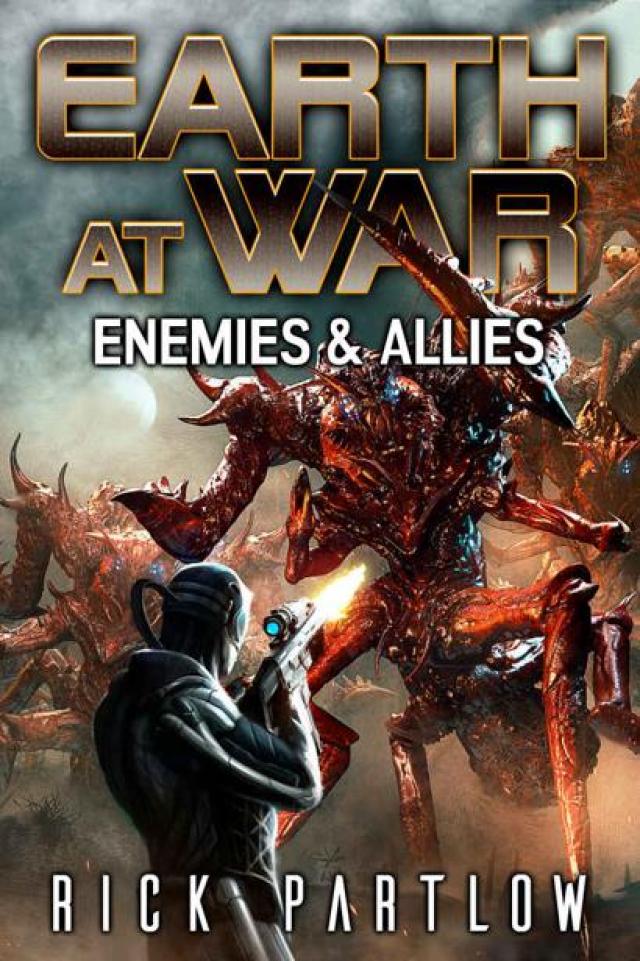
Enemies & Allies
By Rick Partlow
Book 4 of Earth at War, a military science fiction series.
Copyrighted Material
© Rick Partlow 2021
All right reserved.
Cover art by Tom Edwards (tomedwardsdesign.com)
Typography by Steve Beaulieu (facebook.com/BeaulisticBookServices)
Published by Pramantha Publishing
This novel is a work of fiction. All of the characters and events are fictitious. Any resemblance to actual persons living or dead or events is entirely coincidental.
Want to follow Rick Partlow and get access to exclusive deals?
Tap here to sign up to Rick’s author newsletter, where he’ll keep you updated on his upcoming books and even offer occasional sneak previews.
Chapter One
“I don’t understand,” Brady Evans said, his boyish face screwed up in a frown, “why you’re a major.”
“God knows, that makes two of us,” I admitted.
Colonel Evans was, I’d decided four weeks ago when this voyage of the damned started, an asshole. It wasn’t a shock. He was a colonel and I think I could count the number of colonels I’d met who weren’t assholes on one hand and still have a finger left to pick my nose. The thought made my nose itch and I reached through my open visor and rubbed it carefully. The Svalinn powered armor amplified my natural musculature, and breaking my own nose was pretty far up among the things I was trying to avoid.
“No,” Evans insisted, and I might have been uncharitable when I thought of his eyes as piggish, but it was the only word that came to mind. “I mean, you were a first lieutenant when you got out of active duty, right?”
“I was.” I very carefully did not sigh, although I wanted to. Badly. “I went into the reserves and wound up getting kicked up to captain and made a company commander.” I shrugged, though it didn’t register enough for the armor to imitate it. “And then, I promptly retired.”
“So, why major?”
Motherfucker just wouldn’t leave it alone. Why couldn’t he have ridden in the other shuttle with the rest of the Ranger company’s headquarters platoon like Dani Brookes always did?
“Mostly because I don’t fit in the command structure,” I said, past caring how it sounded. “I started out as an advisor with no command and no real duties other than to be Jiminy Cricket on Colonel Olivera’s shoulder.”
“Jiminy who?”
Dude, you are not younger than me, so don’t even fucking start…
“Not important. Anyway, Olivera didn’t want me to be a captain because he didn’t want the Ranger company commanders thinking they could order me around, so they brought me in as a major.”
“Okay, I get that,” he said, with an expression like he’d just passed a particularly stubborn turd. “But Jesus…you won the Medal. I mean, the Medal. And you’ve seen more dismounted combat off-planet than anyone alive. You’re leading Reaction Force One.”
I winced. Pops hated that name. His Delta team—well, my Delta team now, though I still had trouble thinking of it that way—had a name and a designator and by God, that was still who they were, even if they operated on other planets now and had a dumbass Marine major for a commanding officer. But I suppose that the Joint Chiefs had a point, that they were special, but they were not going to be unique much longer. They…we…had been too successful for that. So, we were Reaction Force One now, and Reaction Force Two was already in training and selection was underway for Reaction Force Three. And because of diversity, Two was made up of Navy SEALs and probably already had a book deal. Three would probably be Royal Marines or French Foreign Legion or something.
“Yeah. And maybe when we get back, they’ll kick me up to light colonel. But after….” I closed my eyes, trying not to choke on the words because it was another lame-ass, melodramatic name we all hated. “After the Battle for Earth, Julie and I were set on getting out, so no one was bothering, you know?”
“What changed your mind?”
“Well, we’re going out farther than anyone in the whole Alliance has gone before,” I reminded him, “trying to find the lost gods who created four races out of Earth animals and terraformed hundreds of planets. How many people do you know who could resist that?”
“So far, all we’ve seen is one lifeless planet after another,” Evans said, making a face. Which was difficult, since he pretty much always looked like he was making a face. “I hope to God this one is different.”
“If you two are done whining,” Julie Nieves said, “we’re about to jump.” Whoops. Julie Clanton now. We hadn’t been married long enough for me to get used to that.
“You’d whine, too,” I told her, grinning just at the sound of her voice in my ear, “if you were stuck in a damned shuttle every time we jumped into a new star system.”
“Think how I feel,” Pops put in from the seat to my right-hand side, just behind the shuttle’s copilot. “I’m stuck in here and I have to listen to you whine.”
Chief Warrant Officer Mark Tremonti had earned the nickname Pops by virtue of being the oldest man on the Delta team back when Jambo had led it. He was still the oldest, though you couldn’t tell it just by looking at him anymore. The Helta genetic therapy that they’d made available to all of us puny humans had reversed the aging process for those of us past our prime, and Pops looked a lot more like the guy in his induction ceremony photo than he did the grizzled old veteran I’d met back at the beginning of this whole thing.
“You should all know the official Space Force technical term for the process by now,” General Michael Olivera reminded us, chuckling. “It’s hyperdimensional translation, not hyperspace jump. This is not a science fiction movie, after all, particularly not a shitty one.”
“Ooh, low blow,” Julie laughed. “You should know better than to dis his favorite movie, sir.”
“Tell me,” another voice came over the intership comms, a deeper one, not quite human, “what you’re talking about? The translator program is giving me a vague idea of what you mean by the word ‘movie,’ a fictional story told in two-dimensional projection, but what particular story are you talking about?”
It was strange having Anu Neeme Klas on the James Bowie, but he’d insisted on coming along. This was a mission for the whole Alliance and there should be representatives from one of the other races. I was glad it was him, though, instead of one of the weird octopus people. A werewolf I could take, a talking octopus would have been harder to deal with.
“Only the best three movies and one TV series ever made,” I said. “Remind me to play them for you when we get a chance, Anu.”
“There were nine movies and like, six TV series,” Olivera said and I saw red.
“No, there were not,” I snapped, forgetting I was talking to a general. “There were three movies and one TV show and anyone who says anything else is a damned liar!”
“Boys,” Julie murmured. “Focus. Hyperdimensional translation in ten seconds.”
She didn’t count down from ten because she knew I hated it.
Instead, we just jumped. Coming in and out of hyperspace wasn’t much easier or more pleasant now than it had been the first time, but I had, perhaps, grown used to the feeling of having my soul ripped out, twisted, folded, spindled and mutilated before being stuffed back into the general vicinity of my body. I shook the sensation off and touched a control on the back of my left forearm to tie into the Jambo’s tactical feed, then pulled down my visor so I could see the Heads-Up Display.
“G-class star,” the ship’s Tactical officer reported. We had another new guy at the position and I couldn’t remember his name for the life of me, so I cheated and checked the roster ID sitting under his station listing. Captain Charles Graciano. That was the problem with crewing the flagship of our fledgling star fleet—they kept cycling new crew through her to get them trained. “We’re at the edge of the system. I’m picking up six planets, I think. Computer says only one in the Goldilocks Zone, though.”
The display was giving me the same information if I knew how to read it correctly, but the narration simplified things, and I could put the glowing dots the computer projected on the app into some sort of perspective. The farthest out was an ice giant, decorated with a set of rings, then two gas giants, smaller than Saturn but still respectable, each carrying a complement of about a dozen moons. Then an asteroid belt, becaus
But has anyone been eating the porridge?
“Are we getting any signs of civilization?” Olivera asked the question in a much more serious way than I had in my head.
“No transmissions on the electromagnetic spectrum, sir,” the Communications officer piped up. He was a Brit, among the first of the international crews the Space Force was fielding as a bone thrown to our allies. Lt. Rajiv Shah was competent at his job, but I’d never forgive him for displacing our last Communications officer, Lt. Adams, who had been as big of a sci-fi geek as I was.
“I’m not picking up any space activity yet, sir,” Graciano reported. “No exhausts, no thermal signatures, no spectroscopic analysis results.”
“Well, damn,” Evans murmured.
Even Olivera sighed. He was as tired of dry holes as the rest of us.
“The planet is definitely habitable, though,” Graciano added. “Spectroscopic analysis confirms a nitrogen-oxygen atmosphere.”
“I suppose that’s something,” Olivera said. “Might as well get a closer look. Jump us in to minimum safe distance, Julie, then make for high orbit.”
“Aye, sir. You heard the commander, guys and gals, it’s a microjump. Clench up and try not to puke.”
“Joy,” Sgt. Randy Quinn commented. “I think I’d almost rather get shot at.”
He was somewhere behind me, strapped in with the rest of Reaction Force One. He had been a Ranger, part of the very first company assigned to the ship, but after he’d distinguished himself in multiple battles, I’d asked for him to be assigned to the team. Even with the new TO&E and them not strictly being a US Army Special Operations Detachment Delta team anymore, Pops hadn’t been completely sold on allowing anyone on the team who hadn’t been through selection. But we both figured he’d proven himself, and God knows, we had holes to fill. He had not, as of yet, earned a nickname. You didn’t choose a nickname on the team, one got chosen for you, and not lightly. I’d suggested “Tarzan” for his part in the now-legendary elk hunt that had solidified our friendship with the Skrith in general and Anu Neeme Klas in particular, but Pop had insisted that the action had happened before he was part of the team and was thus ineligible for nickname status.
“Maybe them damned SEALs hand out nicknames like candy,” he’d said, stubborn as a mule, “but that ain’t us. We may be Reaction Force One now, but some things ain’t gonna change.”
“Jumping now.”
The “jumping now” wasn’t the bad part. It was the next jumping now that hurt. Microjumps inside a single star system meant spending only seconds inside hyperspace before hopping back out again. And if jumping once was a punch in the gut, doing it twice in a few seconds was a kick in the balls. Metaphorically. By a metaphorical NFL kicker who was trying to make a sixty-yard field goal in a playoff game.
“And we’re through.” Like I needed the announcement. The muscle spasms and the existential crisis that went with them told the story very well.
It took me a moment to refocus my eyes, but when I did, a blue-green planet filled my vision. It looked a lot like Earth, though the continents didn’t match up, of course. A bit less land, or maybe the land was just spread out into more islands, with shallow seas between.
“Pretty,” Quinn said. I wasn’t surprised he was savvy enough to link into the feed. He’d been doing this as long as I had. “Bet the fishing’s good.”
“This place have a name yet, General?” I asked Olivera.
“Not unless the Alliance gave it one,” he said. “Anu Neeme Klas?”
“We have not,” the Skrith ambassador assured us. “Not even the Helta and Chamblisi have sent probes this far from our home systems. To us, these stars are numbers on a map, and the planets not even that.”
“We should call it Fishing Hole,” I suggested. “Sgt. Quinn observed that there was probably good fishing down there and we should be thinking long term. Someone’s gonna make a killing on extraterrestrial real estate and I don’t see why it can’t be us.”
“We’re in position for drone launch, sir,” Julie said, ignoring me.
“Still nothing on the sensors?” Olivera took the hint and did the same, which I found vaguely annoying.
“Nothing that would indicate heavy industry,” Graciano told him. “We’re not gonna see much more from up here.”
“Launch the drones.”
The drones were something new, brought in especially for this mission. They were cheap and simple and disposable and everything the military wasn’t, which was because they were the brainchild of Daniel Gatlin, the eccentric entrepreneur whose private lunar orbiter I’d been aboard when the Helta first showed up in our system. He’d been on a personal crusade to remake the military procurement process in his own image ever since we’d been invited into the Alliance, and these were his latest.
Off-the-shelf rocket motors, off-the-shelf ablative material left over from Orion capsules no one used anymore, off-the-shelf surveillance drones that would have been sold as surplus otherwise. The only non-standard equipment was the satellite transceiver, and even that was pulled off another defense contract that was moribund due to alien technology. There was much wailing and gnashing of teeth in the military-industrial complex, and there’d been just as much yelling and screaming in Congress, but ultimately, being the first constituency to receive fusion reactors and industrial fabricators had overruled the few hundred suddenly-obsolete defense production jobs.
I still wasn’t sure if I was okay with that. Ultimately, we’d expand out to Alpha Centauri and some of the former Tevynian colonies, and there’d be plenty of opportunities for work, but at the moment, we were headed for a pyramid economy where all the technical jobs were centrally controlled and everyone at the bottom was well-fed, well-entertained and taken care of, but useless. I’d written dystopian novels that started that way. The current administration understood that, and President Crenshaw had assured me he had plans to avoid it, but administrations didn’t last forever. Maybe we’d moved past the point in history where a new administration could undo everything that had been done, maybe it had a momentum of its own and we’d finally start to act like rational people.
Oh, good God, I write science fiction, I’ve been to other star systems, I’ve talked to intelligent bears and wolves and even I couldn’t buy that.
“Drones are in atmosphere,” Graciano announced. “Ablative shells have been ejected and parachutes deployed.”
I was still tied into the Tactical station and it only took another flick of the controls on the back of my wrist to loop me into the feed from the drones. There were four of them and the display was quartered in the upper left corner of my HUD, which made everything almost too small to see, but all I had to do was stare at one of the sections for a second or two and it expanded to fill my vision.
Two of them were coming in on the nightside, and although the thermal and infrared cameras were giving us data, there was something more viscerally satisfying about the daylight feed so I chose one of those to bring up. The image bobbed like a pendulum, swinging lightly at the end of the parachute cords, waiting for the altitude where it would be cut loose and use its wings and propellor. I could have been staring out of an airplane window over the Pacific, though the islands below were larger than the ones I’d seen on Earth. Not quite Australia-New Zealand large, but big enough.
When the drone separated from the parachute, my stomach dropped with it and I had to clench my teeth and close my eyes to reestablish my sense of up and down. The flight was quick, the descent a roller-coaster, and I wondered if Graciano knew I’d dialed in and was trying to give me motion sickness, but once it leveled off, I forgot all about my stomach and my inner ear and stared at the rolling waves of the sea off the largest island.
There were boats on the water.
“Is anyone else seeing this?” I wondered.
“Take the drone lower, Graciano,” Olivera ordered. “Get me a look at whoever’s running those things.”
The boats were nothing to write home about, no three-masted schooners or triremes with banks or oarsmen. Outrigger canoes. That was what they looked most like, though with some kind of crude sail hung up as well. Technology that predated metallurgy and could have been produced with tools fashioned out of lava rock. As the drone descended, coming close enough for them to see it, the stick-figure humanoids at the oars began pointing, gesticulating in what might have been a panic or maybe a religious fervor. They were wearing some sort of cloaks, I thought, something multicolored and gaudy that went from head to toe except for a leather harness over their torsos. That was what I thought at first.