Host, p.3
Host, page 3
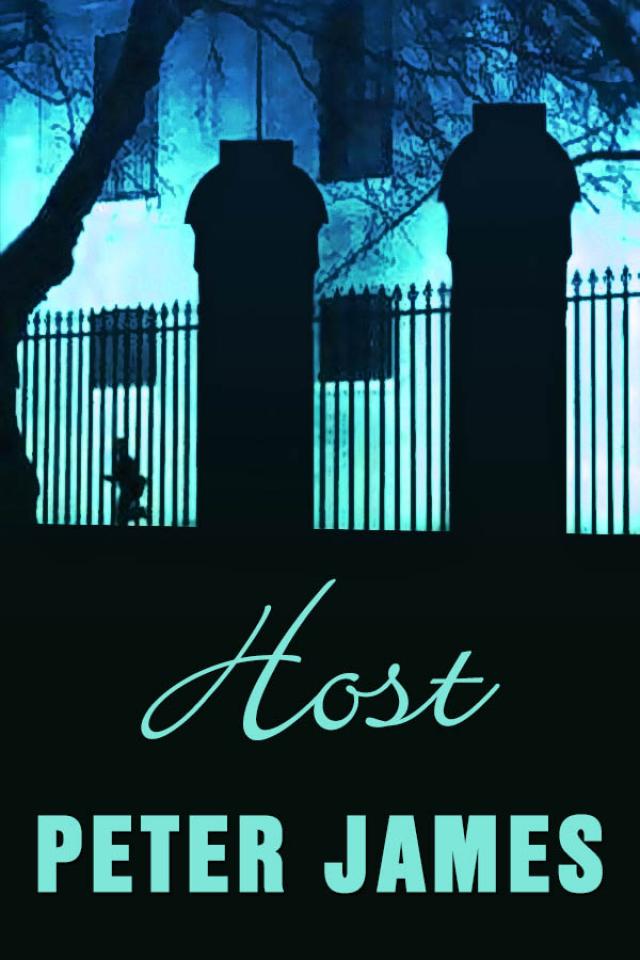


Although there were windows along the front facade visible to the street, it was impossible to see in, and both the sides and the rear were kept private by an electric sliding gate and high walls.
Some people who knew what the building was quickened their pace as they walked by; others slowed in morbid curiosity, glancing at the electronic security system on the front door and wondering at the absence of any company name displayed there. As with any place that cloaked itself in secrecy, dark rumours abounded. A few of the neighbourhood’s more religious residents actually crossed the street to avoid passing too close.
At a quarter past midnight few people were around to see the Ford truck pull up outside the rear gates. The driver pressed the buzzer and gave his name: ‘Warren Otak,’ he said. The gates slid open to allow the truck entry, then closed behind it again. The truck was a three-ton closed van painted bright orange; bold lettering on the side proclaimed ‘Budget Self-Drive Truck Rentals’.
Otak drove into the yard at the rear, turned the truck around and backed it up against the loading-bay platform. The metal security door in the building began to rise with a clatter that seemed to shatter the quiet of the muggy night. Four men stood inside, three in suits, one in the uniform of a security guard. A cigar-shaped aluminium tube, nine feet long and four in diameter, lay on its side, cradled in a dense nest of padding, and strapped securely to a wheeled trolley. A grey gas bottle, carrying a warning symbol and the words LIQUID NITROGEN, was clipped to the cylinder and hooked up to a valve on the side via a short pipe. Streaks of red from the truck’s rear lights reflected in the metallic shine of the aluminium. It reminded Warren Otak of a section of a space craft.
One of the men in suits showed Otak and his assistant, Arnie Becks, two temperature gauges on the tube; both were calibrated in Celsius and the dials were reading – 140. ‘There’s a variation tolerance of plus or minus five degrees maximum,’ he said. He showed them how to lower the temperature by adding more gas, and how to decrease by venting gas. Then he gave each man an oxygen mask and showed them how to use it. ‘In case of emergency,’ he said. He also handed them two packs containing protective body suits, boots and gloves.
It took an hour and a half to load the tube. First, the floor of the truck had to be packed with layers of foam, then the tube had to be lowered on to a cradle and anchored in place with straps. Otak and Becks were warned repeatedly of the fragility of their cargo. A sharp jolt of any kind could be a disaster. Otak was given a maximum speed limit of ten m.p.h. – it was enough, the man said, to get him to his destination before the morning traffic began.
‘No problem,’ Otak replied, more breezily than he felt. He switched on his hazard flashers, pulled out of the yard, crawled a few blocks south down La Cienega, then turned east.
They drove in silence for some minutes. Becks peered over his shoulder periodically to check their cargo.
‘Gives me the creeps, that thing,’ Otak said.
‘You’re full of shit. Everything gives you the creeps.’
‘Eat my shorts!’ Otak looked nervously in his wing mirror. Darkness seemed to be closing in, swallowing up the lights of the city and the other vehicles behind them. Cold, icy darkness that drained all the heat from the night.
The patrol car pulled them up just over an hour later. Otak was surprised they had not been stopped sooner.
‘You have a problem?’ one of the cops said.
Otak stared into the beam of the torch and blinked at the shadowy figure beyond it. Twin red lights flashed on the patrol car’s roof. ‘Nope,’ he said, failing to stem his natural sullenness towards all police. ‘No problem.’
‘You were doing fourteen miles an hour.’
‘Yup – well, I’m real nervous of breaking the limit – don’t want no points on my clean licence.’ Otak knew as soon as he had said it that it was the wrong thing; if the cop had a sense of humour, he hadn’t brought it with him.
The cop shone his torch at Arnie Becks’ face. Becks kept silent. He shone it back at Otak. ‘Can I see your driver’s licence?’
Otak fished in his jacket and pulled out his wallet. The cop studied the licence, glancing at Otak’s face a couple of times in the process, then handed it back. ‘What do you have in the back?’ he said.
Otak caught Becks’ smirk out of the corner of his eye, and it infected him; he broke into a broad grin, and saw the cop’s suspicion and hostility increasing.
‘Have you been drinking liquor tonight, Mr Otak?’ came the next question, the cop moving his face closer to smell Otak’s breath.
‘I don’t drink liquor.’
‘Have you been taking narcotics?’
‘I don’t take narcotics,’ Otak replied, unable to stop himself grinning again. Only this time some of his humour evaporated from the grin. Narcotics. The significance of the word sank in a bit more strongly.
Narcotics!
Panic rose inside him. He stifled it. No way. They couldn’t have done that to him. Otak saw the cop had noticed the change in his expression. He’d accepted the job on trust; on faith. What it involved had seemed so bizarre that it had to be true. Now he began to have doubts. Maybe this business about fragility was bull; maybe he was the victim of some set-up, some tuck-up. His brain raced, trying to make sense; trying to think how he could cover his tracks, prove his innocence; he felt his hands go clammy.
‘Would you like to open the rear of the truck for me, gentlemen?’
Otak saw that a second cop was sitting in the car, watching them and talking on the radio. He climbed down, trembling a little, trying to convince himself that he didn’t need to be nervous, everything was fine. No one was dumb enough to hire him to drive a truck loaded with narcotics through LA in the dead of night at ten miles per hour.
He unlatched the back doors and swung them open. The cop shone his flashlight in. The aluminium tube glinted. The cop studied it for some moments, running his beam carefully over it, down at the foam, then back over the tube. ‘What do you have in there?’ he said.
Otak looked back at him and felt a lump of anxiety in his throat; at the same time, the grin broke out again on his face. He felt both a little foolish and a little hopeful: ‘A dead body,’ he said.
3
Saturday 9 January, 1993. Sussex.
The video camera silently recorded Joe Messenger as he sat at the breakfast table, mechanically spooning whole-grain cereal into his mouth and scanning through the pages of The Times.
His mind was elsewhere, as it frequently was, at this moment running through his teaching curriculum for the forthcoming spring term at the Isaac Newton University, where he was Professor of Computer Science. He nearly missed the short column towards the bottom of the Overseas News page: FROZEN CORPSES COMPANY ON ICE.
Joe liked to read The Times at breakfast every morning; it was still a treat, even after four years, something quintessentially British, like Dundee marmalade, and having milk delivered in glass bottles. The Times had been around for over two hundred years. Joe admired that. He admired anything that was capable of outstripping the human lifespan of three score years and ten. Like the small Koi carp that swam around the glass bowl on the Welsh dresser beside him. Koi lived for over two hundred years as well.
England had been good to Joe. Sure there were things here that frustrated him, particularly the lack of respect and support given to scientific research. In America research was sacrosanct; here in England, scientists scratched around for funding and lived on meagre pay. And yet some of the greatest inventive minds on earth were here. But he was lucky; he had been lured over with the promise of unlimited funding and no hassle, and so far it was working out fine. The only hassle was his wife, Karen. It wasn’t her fault, but he didn’t know the solution.
She was unhappy and frustrated, and the support she had once given him so ardently seemed to have waned. Their biggest bone of contention was over the video cameras that were in every room of the house, and on every outside wall. Joe didn’t notice them at all any more. They’d been there so long, he paid them no more attention than if they had been burglar-alarm sensors, although at first he, too, had been self-conscious in their presence. After the first fortnight Karen had put her foot down and insisted he remove the ones in the bedroom and the bathroom. He had done so, then a few days later, when she was out, he had put them back again, concealed.
As if reading Joe’s mind, Karen looked up from the breakfast table at the silent electronic eye that was recording her husband chewing his cereal, their three-year-old son, Jack, reading his comic, and herself peeling the foil from an apple-and-walnut yoghurt.
‘Don’t let your egg get cold, Jack,’ she said.
Obediently he pushed his comic to one side, picked up his spoon and scooped the white out of the cap of his boiled egg. Then as he ate it he removed one of the four soldiers into which she had cut his toast, and rearranged the remaining three into a triangle. She watched him fondly, his hair the colour of winter wheat flopped down over his forehead.
‘Daddy?’ he said gently, as if afraid of disturbing his father.
Joe glanced at him. ‘Uh?’
Jack pointed at the three strips of bread. ‘Is that a triangle, Daddy?’
Karen felt a warm glow as Joe smiled back at him. ‘Yup, pretty good,’ he said. ‘Now you want to make a square?’
Jack opened up the triangle and put the fourth soldier down.
‘That’s heat,’ Joe said. ‘OK, now how about a –’
‘Hon,’ Karen interrupted. ‘I think he should eat his break-fast.’ She caught the flash of irritation in her husband’s face and felt a twinge of guilt. She knew how keen Joe was to foster Jack’s interest in science and she was happy about that, but sometimes it bordered on the obsessional. Joe was obsessive about everything he did. All the way or not at all.
Like the cameras.
He’d told her she would get used to the cameras in time, but she hadn’t. She found herself sometimes deliberately trying to skirt along the walls to get out of their line of vision, but a faint whirr of motors would tell her they were panning down, tilting, focusing. That she had not escaped. Gotchya! They were picking up every detail of her life; of their lives. Every movement they made, every sound they uttered was filed on-line to ARCHIVE – the computer that was a would-be human – encoded into hexadecimal digits and stored.
The computer was the bane of her life and sometimes she wished it was dead. It was bizarre, she knew, to wish death on a computer; for it meant that a part of her was acknowledging what she was not willing to admit: that ARCHIVE could in any way be alive. It could not! Except in Joe’s mind. She instructed herself that no computer could ever be aware of its own existence, have emotions, fall in love, watch two adult human beings living their lives and begin to make any sense of what that was all about. Could it?
Karen had met Joe at the University of Toronto. She’d been a freshman English Lit undergraduate, and had got involved with the university’s magazine. She’d been assigned to interview this crazy postdoc boffin who reckoned he knew how to make computers have orgasms, and was working on ways to download a human brain. To her surprise, she had found not some bespectacled scatterbrained nerd, but a startlingly articulate and handsome fair-haired man, who looked more like a rugged adventurer than a scientist.
Within a few minutes of talking to Joe, she had realized that his ideas were more than just wild fancy. He was a man who was going to make them happen. He was only twenty-seven but he had utter conviction and a hint of ruthlessness that she found both frightening and exciting.
Two months later they were engaged. Even though Joe had Jewish lineage through his grandparents, it had caused outrage in her strictly Orthodox family that she was not marrying a Jew, outrage which had been mitigated only very slightly by the fact that he was a doctor of science. And mitigated further, eventually, by the fact that although a firm non-believer, Joe had shown respect and understanding for their customs and regularly joined their celebrations of the Sabbath.
The first few years of marriage had been an undeniably happy time. Joe’s career had taken off meteorically when in his early thirties he had won a MacArthur Prize for his work on neural networks. And Karen had been carried along by his enthusiasm.
Joe believed that death could be defeated by the process of humans downloading their own brains into computers. And for a time she not only had believed he could make it happen but had also really wanted him to, and had defended him vigorously at college dinners if he came under attack.
But not any more.
Barty had changed her. Barty had been born in their second year of marriage and Joe had doted on him. Then when Barty was three, he had been killed in a car crash. Joe had managed to cope with it, somehow, but she hadn’t. Joe had been kind to her, had shown a side to him that she had never realized existed, a depth of emotion and caring that had helped her somehow to get through the three years of hell that had followed. Their grief, more than anything else, had bonded them together. But her job had helped, too.
Before she met Joe, Karen had been ambitious to work in documentary television: she’d nurtured dreams of being both a television presenter and a magazine columnist. In a compartment of her mind there still lay a fantasy that she would one day write regularly for the New Yorker. After university, she’d stepped on to the first rung of her career ladder by getting a job as a television researcher in Toronto. But maternity leave for Barty’s birth had curtailed her immediate prospects of promotion. And although she had returned to work three months later, she found Barty had become the new focus of her life and her ambitions seemed less important. After Barty’s death, she’d worked hard to cling on to her job, and the supportive friendship of her colleagues helped pull her through those years.
Then, when she was two months pregnant with Jack, Joe had been offered the research project of his dreams in England, together with a professorship at a leading university. She’d jumped at the idea of moving to England; a break with the past; a new beginning. But now she felt that in moving from their memories they had moved from their roots. And she missed work a lot. Joe was getting more handsome with age and she was scared that her own looks would go. There was always a magnetism about him when he walked into a room, and she could see the interest in other women’s faces, watched them flirt with him. She had never been concerned in the past, but it was beginning to worry her now.
She looked at her husband across the table, dressed in one of the soft, button-down shirts he almost invariably wore, with a tie during weekdays, and open-necked beneath a sleeveless jumper at weekends. The years had flattered him. Given him just a few wrinkles that had etched additional wisdom and authority into his features. His blue eyes nestled comfortably between the crow’s feet, sparkling with light and with life, and often filled with an expression of wonder, as if he was seeing everything in the world for the first time. Except where once she had seen wisdom she now saw naivety.
And she wondered what he saw when he looked at her. She was still attractive, she knew that. And she wanted to keep it that way. She’d put on weight after being pregnant with Jack and had not managed to get rid of it all, but fortunately at five feet seven inches she was tall enough to carry a few extra pounds. And by maintaining her luxurious black wavy hair at shoulder length it seemed to keep her face looking reasonably slim, and to give her an air of elegance. Her complexion was the thing that bothered her most. Ever since that second pregnancy, she thought it had become too sallow.
She was always trying natural tonics, bought organic soaps and skin shampoos from the Body Shop, and even made potions up from cranky recipes she read in magazines. One, which seemed to work better than the rest, contained a mineral extracted from goat’s faeces – much to Joe’s amusement. But what her doctor had said was probably right, she realized. England was stressful for her; Jack was starting at playschool in a couple of weeks and that would at least give her some time to herself. Maybe that would improve things dramatically. Life owed her a break.
When Joe had originally mentioned the offer from the Isaac Newton University, part of the reason why the idea of moving to England had appealed so highly was because she had visited London fleetingly as a student fourteen years before and had fallen in love with it. The reality, as is often the case, was different.
Karen’s first shock was to discover that the university wasn’t in London at all, but fifty miles south, only a few miles inland from the English Channel. Her second shock was to discover quite how much she missed her family, particularly her sister Arlene, and friends in Toronto, a city she had never previously left for longer than a month. And how much she also missed the camaraderie of working life. Their new social circle consisted almost entirely of Joe’s colleagues from the university. Computing-science lecturers, researchers and professors, mostly, with whom she had little in common, and a motley collection of partners.
She also felt isolated and adrift in their house. In Toronto she’d had a mental image of moving to the faded grandeur of an old London terrace, to a huge old apartment with oak floors, and high ceilings with cornices and mouldings. Instead they’d moved to a four-bedroom detached 1920s mock-Tudor house in a smart, dinky suburb of a provincial seaside resort, where every property was a mock-something-or-other.
Number 8 Cranford Road belonged to another professor at the university who’d taken a five-year posting abroad; they’d rented it for six months while they had a chance to look around, and three and a half years on they were still looking around. That was as much her fault as Joe’s, she knew, probably more so. She hadn’t felt settled enough over here to commit to buying a property. Yet at the same time she resented living in someone else’s house, because she was unable to redecorate it or furnish it in the way she would have liked.
Joe had his work to absorb him and the social contact that went with it, and was so engrossed with Jack in the few hours that he was at home and not thinking about work that he failed to notice her growing unhappiness. She had even agreed to the installation of the cameras because she felt that might give Joe more of an interest in their home.