

The complete works of he.., p.1
The Complete Works of Henry James, page 1
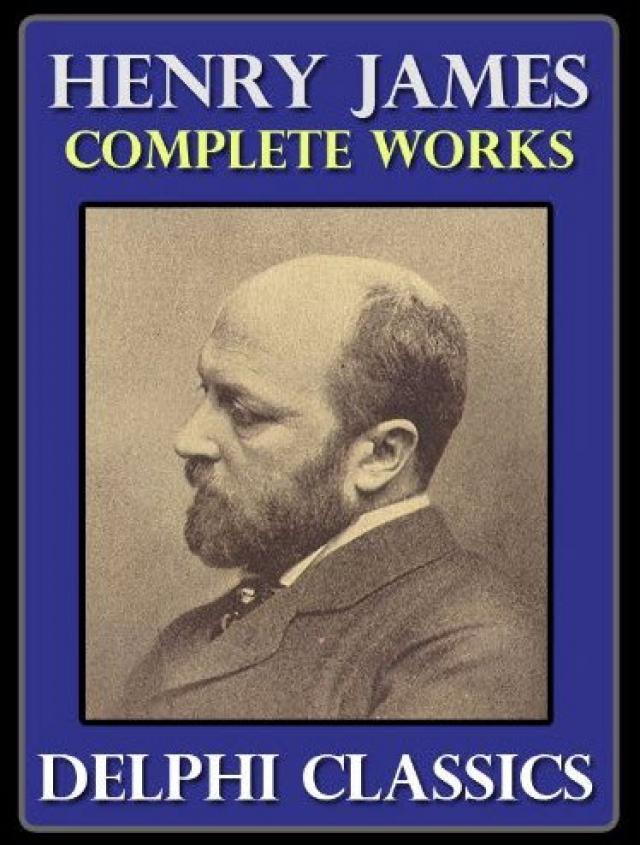


The Complete Works of Henry James
© 2009
Table of Contents:
The Altar of the Dead
The Ambassadors
The American
The American Scene
The Aspern Papers
The Author of Beltraffio
The Awkward Age
The Beast in the Jungle
The Beldonald Holbein
The Bostonians: Volume I
The Bostonians: Volume II
A Bundle of Letters
The Chaperon
Confidence
The Coxon Fund
Daisy Miller: A Study in Two Parts
The Death of the Lion
The Diary of a Man of Fifty
Embarrassments
Eugene Pickering
The Europeans
The Figure in the Carpet
The Finer Grain
Four Meetings
Georgina’s Reasons
Glasses
The Golden Bowl
Greville Fane
Hawthorne
An International Episode
Italian Hours
The Jolly Corner
The Lesson of the Master
A Little Tour in France
A London Life; The Patagonia; The Liar
Louisa Pallant
Madame de Mauves
The Madonna of the Future
The Marriages
Nona Vincent
The Outcry
Pandora
A Passionate Pilgrim
The Patagonia
The Path of Duty
The Pension Beaurepas
Picture and Text
The Point of View
The Portrait of a Lady
The Pupil
The Real Thing
The Reverberator
Roderick Hudson
Sir Dominick Ferrand
A Small Boy and Others
Some Short Stories
The Tragic Muse
The Turn of the Screw
Washington Square
What Maisie Knew
The Wings of the Dove
The Altar of the Dead
CHAPTER I
He had a mortal dislike, poor Stransom, to lean anniversaries, and loved them still less when they made a pretence of a figure. Celebrations and suppressions were equally painful to him, and but one of the former found a place in his life. He had kept each year in his own fashion the date of Mary Antrim’s death. It would be more to the point perhaps to say that this occasion kept HIM: it kept him at least effectually from doing anything else. It took hold of him again and again with a hand of which time had softened but never loosened the touch. He waked to his feast of memory as consciously as he would have waked to his marriage-morn. Marriage had had of old but too little to say to the matter: for the girl who was to have been his bride there had been no bridal embrace. She had died of a malignant fever after the wedding-day had been fixed, and he had lost before fairly tasting it an affection that promised to fill his life to the brim.
Of that benediction, however, it would have been false to say this life could really be emptied: it was still ruled by a pale ghost, still ordered by a sovereign presence. He had not been a man of numerous passions, and even in all these years no sense had grown stronger with him than the sense of being bereft. He had needed no priest and no altar to make him for ever widowed. He had done many things in the world—he had done almost all but one: he had never, never forgotten. He had tried to put into his existence whatever else might take up room in it, but had failed to make it more than a house of which the mistress was eternally absent. She was most absent of all on the recurrent December day that his tenacity set apart. He had no arranged observance of it, but his nerves made it all their own. They drove him forth without mercy, and the goal of his pilgrimage was far. She had been buried in a London suburb, a part then of Nature’s breast, but which he had seen lose one after another every feature of freshness. It was in truth during the moments he stood there that his eyes beheld the place least. They looked at another image, they opened to another light. Was it a credible future? Was it an incredible past? Whatever the answer it was an immense escape from the actual.
It’s true that if there weren’t other dates than this there were other memories; and by the time George Stransom was fifty-five such memories had greatly multiplied. There were other ghosts in his life than the ghost of Mary Antrim. He had perhaps not had more losses than most men, but he had counted his losses more; he hadn’t seen death more closely, but had in a manner felt it more deeply. He had formed little by little the habit of numbering his Dead: it had come to him early in life that there was something one had to do for them. They were there in their simplified intensified essence, their conscious absence and expressive patience, as personally there as if they had only been stricken dumb. When all sense of them failed, all sound of them ceased, it was as if their purgatory were really still on earth: they asked so little that they got, poor things, even less, and died again, died every day, of the hard usage of life. They had no organised service, no reserved place, no honour, no shelter, no safety. Even ungenerous people provided for the living, but even those who were called most generous did nothing for the others. So on George Stransom’s part had grown up with the years a resolve that he at least would do something, do it, that is, for his own—would perform the great charity without reproach. Every man HAD his own, and every man had, to meet this charity, the ample resources of the soul.
It was doubtless the voice of Mary Antrim that spoke for them best; as the years at any rate went by he found himself in regular communion with these postponed pensioners, those whom indeed he always called in his thoughts the Others. He spared them the moments, he organised the charity. Quite how it had risen he probably never could have told you, but what came to pass was that an altar, such as was after all within everybody’s compass, lighted with perpetual candles and dedicated to these secret rites, reared itself in his spiritual spaces. He had wondered of old, in some embarrassment, whether he had a religion; being very sure, and not a little content, that he hadn’t at all events the religion some of the people he had known wanted him to have. Gradually this question was straightened out for him: it became clear to him that the religion instilled by his earliest consciousness had been simply the religion of the Dead. It suited his inclination, it satisfied his spirit, it gave employment to his piety. It answered his love of great offices, of a solemn and splendid ritual; for no shrine could be more bedecked and no ceremonial more stately than those to which his worship was attached. He had no imagination about these things but that they were accessible to any one who should feel the need of them. The poorest could build such temples of the spirit—could make them blaze with candles and smoke with incense, make them flush with pictures and flowers. The cost, in the common phrase, of keeping them up fell wholly on the generous heart.
CHAPTER II.
He had this year, on the eve of his anniversary, as happened, an emotion not unconnected with that range of feeling. Walking home at the close of a busy day he was arrested in the London street by the particular effect of a shop-front that lighted the dull brown air with its mercenary grin and before which several persons were gathered. It was the window of a jeweller whose diamonds and sapphires seemed to laugh, in flashes like high notes of sound, with the mere joy of knowing how much more they were “worth” than most of the dingy pedestrians staring at them from the other side of the pane. Stransom lingered long enough to suspend, in a vision, a string of pearls about the white neck of Mary Antrim, and then was kept an instant longer by the sound of a voice he knew. Next him was a mumbling old woman, and beyond the old woman a gentleman with a lady on his arm. It was from him, from Paul Creston, the voice had proceeded: he was talking with the lady of some precious object in the window. Stransom had no sooner recognised him than the old woman turned away; but just with this growth of opportunity came a felt strangeness that stayed him in the very act of laying his hand on his friend’s arm. It lasted but the instant, only that space sufficed for the flash of a wild question. Was NOT Mrs. Creston dead?—the ambiguity met him there in the short drop of her husband’s voice, the drop conjugal, if it ever was, and in the way the two figures leaned to each other. Creston, making a step to look at something else, came nearer, glanced at him, started and exclaimed—behaviour the effect of which was at first only to leave Stransom staring, staring back across the months at the different face, the wholly other face, the poor man had shown him last, the blurred ravaged mask bent over the open grave by which they had stood together. That son of affliction wasn’t in mourning now; he detached his arm from his companion’s to grasp the hand of the older friend. He coloured as well as smiled in the strong light of the shop when Stransom raised a tentative hat to the lady. Stransom had just time to see she was pretty before he found himself gaping at a fact more portentous. “My dear fellow, let me make you acquainted with my wife.”
Creston had blushed and stammered over it, but in half a minute, at the rate we live in polite society, it had practically become, for our friend, the mere memory of a shock. They stood there and laughed and talked; Stransom had instantly whisked the shock out of the way, to keep it for private consumption. He felt himself grimace, he heard himself exaggerate the proper, but was conscious of turning not a little faint. That new woman, that hired performer, Mrs. Creston? Mrs. Creston had been more living for him than any woman but one. This lady had a face that shone as publicly as the jeweller’s window, and in the happy candour with which she wore her monstrous character was an effect of gross immodesty. The character of Paul Creston’s wife thus attributed to her was monstrous for reasons Stransom could judge his friend to know perfectly that he knew. The happy pair had just arrived from America, and Stransom hadn’t needed to be told this to guess the nationality of the lady. Somehow it deepened the foolish air that her husband’s confused cordiality was unable to conceal. Stransom recalled that he had heard of poor Creston’s having, while his bereavement was still fresh, crossed the sea for what people in such predicaments call a little change. He had found the little change indeed, he had brought the little change back; it was the little change that stood there and that, do what he would, he couldn’t, while he showed those high front teeth of his, look other than a conscious ass about. They were going into the shop, Mrs. Creston said, and she begged Mr. Stransom to come with them and help to decide. He thanked her, opening his watch and pleading an engagement for which he was already late, and they parted while she shrieked into the fog, “Mind now you come to see me right away!” Creston had had the delicacy not to suggest that, and Stransom hoped it hurt him somewhere to hear her scream it to all the echoes.
He felt quite determined, as he walked away, never in his life to go near her. She was perhaps a human being, but Creston oughtn’t to have shown her without precautions, oughtn’t indeed to have shown her at all. His precautions should have been those of a forger or a murderer, and the people at home would never have mentioned extradition. This was a wife for foreign service or purely external use; a decent consideration would have spared her the injury of comparisons. Such was the first flush of George Stransom’s reaction; but as he sat alone that night—there were particular hours he always passed alone—the harshness dropped from it and left only the pity. HE could spend an evening with Kate Creston, if the man to whom she had given everything couldn’t. He had known her twenty years, and she was the only woman for whom he might perhaps have been unfaithful. She was all cleverness and sympathy and charm; her house had been the very easiest in all the world and her friendship the very firmest. Without accidents he had loved her, without accidents every one had loved her: she had made the passions about her as regular as the moon makes the tides. She had been also of course far too good for her husband, but he never suspected it, and in nothing had she been more admirable than in the exquisite art with which she tried to keep every one else (keeping Creston was no trouble) from finding it out. Here was a man to whom she had devoted her life and for whom she had given it up—dying to bring into the world a child of his bed; and she had had only to submit to her fate to have, ere the grass was green on her grave, no more existence for him than a domestic servant he had replaced. The frivolity, the indecency of it made Stransom’s eyes fill; and he had that evening a sturdy sense that he alone, in a world without delicacy, had a right to hold up his head. While he smoked, after dinner, he had a book in his lap, but he had no eyes for his page: his eyes, in the swarming void of things, seemed to have caught Kate Creston’s, and it was into their sad silences he looked. It was to him her sentient spirit had turned, knowing it to be of her he would think. He thought for a long time of how the closed eyes of dead women could still live—how they could open again, in a quiet lamplit room, long after they had looked their last. They had looks that survived—had them as great poets had quoted lines.
The newspaper lay by his chair—the thing that came in the afternoon and the servants thought one wanted; without sense for what was in it he had mechanically unfolded and then dropped it. Before he went to bed he took it up, and this time, at the top of a paragraph, he was caught by five words that made him start. He stood staring, before the fire, at the “Death of Sir Acton Hague, K.C.B.,” the man who ten years earlier had been the nearest of his friends and whose deposition from this eminence had practically left it without an occupant. He had seen him after their rupture, but hadn’t now seen him for years. Standing there before the fire he turned cold as he read what had befallen him. Promoted a short time previous to the governorship of the Westward Islands, Acton Hague had died, in the bleak honour of this exile, of an illness consequent on the bite of a poisonous snake. His career was compressed by the newspaper into a dozen lines, the perusal of which excited on George Stransom’s part no warmer feeling than one of relief at the absence of any mention of their quarrel, an incident accidentally tainted at the time, thanks to their joint immersion in large affairs, with a horrible publicity. Public indeed was the wrong Stransom had, to his own sense, suffered, the insult he had blankly taken from the only man with whom he had ever been intimate; the friend, almost adored, of his University years, the subject, later, of his passionate loyalty: so public that he had never spoken of it to a human creature, so public that he had completely overlooked it. It had made the difference for him that friendship too was all over, but it had only made just that one. The shock of interests had been private, intensely so; but the action taken by Hague had been in the face of men. To-day it all seemed to have occurred merely to the end that George Stransom should think of him as “Hague” and measure exactly how much he himself could resemble a stone. He went cold, suddenly and horribly cold, to bed.
CHAPTER III.
The next day, in the afternoon, in the great grey suburb, he knew his long walk had tired him. In the dreadful cemetery alone he had been on his feet an hour. Instinctively, coming back, they had taken him a devious course, and it was a desert in which no circling cabman hovered over possible prey. He paused on a corner and measured the dreariness; then he made out through the gathered dusk that he was in one of those tracts of London which are less gloomy by night than by day, because, in the former case of the civil gift of light. By day there was nothing, but by night there were lamps, and George Stransom was in a mood that made lamps good in themselves. It wasn’t that they could show him anything, it was only that they could burn clear. To his surprise, however, after a while, they did show him something: the arch of a high doorway approached by a low terrace of steps, in the depth of which—it formed a dim vestibule—the raising of a curtain at the moment he passed gave him a glimpse of an avenue of gloom with a glow of tapers at the end. He stopped and looked up, recognising the place as a church. The thought quickly came to him that since he was tired he might rest there; so that after a moment he had in turn pushed up the leathern curtain and gone in. It was a temple of the old persuasion, and there had evidently been a function—perhaps a service for the dead; the high altar was still a blaze of candles. This was an exhibition he always liked, and he dropped into a seat with relief. More than it had ever yet come home to him it struck him as good there should be churches.
This one was almost empty and the other altars were dim; a verger shuffled about, an old woman coughed, but it seemed to Stransom there was hospitality in the thick sweet air. Was it only the savour of the incense or was it something of larger intention? He had at any rate quitted the great grey suburb and come nearer to the warm centre. He presently ceased to feel intrusive, gaining at last even a sense of community with the only worshipper in his neighbourhood, the sombre presence of a woman, in mourning unrelieved, whose back was all he could see of her and who had sunk deep into prayer at no great distance from him. He wished he could sink, like her, to the very bottom, be as motionless, as rapt in prostration. After a few moments he shifted his seat; it was almost indelicate to be so aware of her. But Stransom subsequently quite lost himself, floating away on the sea of light. If occasions like this had been more frequent in his life he would have had more present the great original type, set up in a myriad temples, of the unapproachable shrine he had erected in his mind. That shrine had begun in vague likeness to church pomps, but the echo had ended by growing more distinct than the sound. The sound now rang out, the type blazed at him with all its fires and with a mystery of radiance in which endless meanings could glow. The thing became as he sat there his appropriate altar and each starry candle an appropriate vow. He numbered them, named them, grouped them—it was the silent roll-call of his Dead. They made together a brightness vast and intense, a brightness in which the mere chapel of his thoughts grew so dim that as it faded away he asked himself if he shouldn’t find his real comfort in some material act, some outward worship.






