

The marvelous adventures.., p.1
The Marvelous Adventures of Serge Myrandhal on Mars, page 1
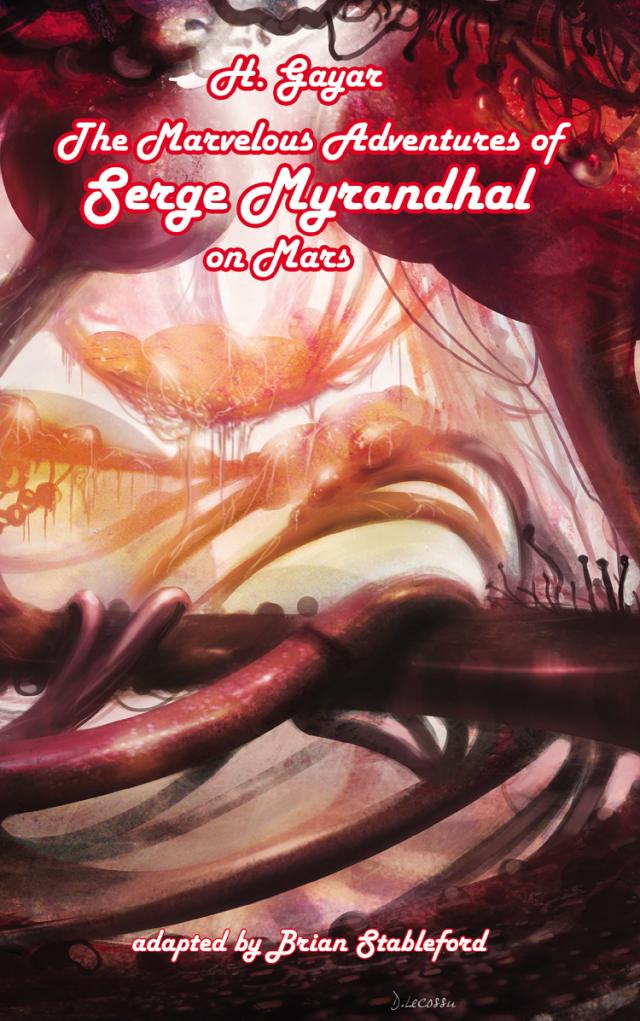


H. Gayar
The Marvelous Adventures
of Serge Myrandhal
on Mars
translated, annotated and introduced by
Brian Stableford
A Black Coat Press Book
TABLE OF CONTENTS
Introduction 4
ON THE PLANET MARS 15
THE CASTAWAYS OF MARS 220
Afterword 404
FRENCH SCIENCE FICTION & FANTASY COLLECTION 411
Introduction
Aventures merveilleuses de Serge Myrandhal sur la planète Mars by H. Gayar, here translated as the first part of The Marvelous Adventures of Serge Myrandhal on Mars, was first published by L. Laumonier et Cie, dated 18 June 1908. A second volume followed, Aventures merveilleuses de Serge Myrandhal: Les Robinsons de la planète Mars, dated 15 July 1908. The catalogue of the Bibliothèque Nationale gives the date of the second volume, wrongly, as 1909, a mistake inevitably copied by numerous other secondary sources—the first of many confusions relating to this strangely problematic text.
The first volume of Serge Myrandhal’s story has attracted particular critical interest because of remarkable similarities with Gustave Le Rouge’s Martian fantasy published in the same year, Le Prisonnier de la planète Mars, in between the two volumes of the Gayar work. Le Rouge’s work was also followed up by a second volume, La Guerre des vampires (1909)1. The similarities between the first item of each pair were pointed out by Pierre Versins in a 1966 essay, which was supplemented by brief comments in the articles on Gayar and Le Rouge is his Encyclopédie de l’utopie, des voyages extraordinaires et de la science-fiction (1972). When the essay was employed as an afterword to a 1976 paperback edition of La Guerre des vampires, some further comment was added by the editor of that volume, Francis Lacassin. Before discussing that issue here, however, it is worth addressing the more elementary problem of who “H. Gayar” might have been.
There is no evidence of the existence of a real person with that name, although the Versins Encyclopédie records a death-date of 1937, tacitly suggesting that there might have been one. Lacassin alleges, en passant, that the author’s name was actually Gaillard, and given that one of the two Henri Gaillards who published work under that name parallel with Gayar’s career did die in 1937, Versins and Lacassin might both have been assuming that he was “Gayar.” However, that Henri Gaillard (1869-1937) was a scholarly Orientalist who is highly unlikely to have committed the many naiveties featured in the adventures of Serge Myrandhal, and even less likely to have been responsible for the other conspicuously downmarket works signed with variants of the Gayar pseudonym. The other Henri Gaillard (1866-1939) whose career ran parallel to Gayar’s was a notable advocate for the deaf and an important pioneer of the teaching of sign-language, again highly unlikely to have been responsible for Gayar’s publications.
It does, of course, seem likely that “Gayar” was derived from “gaillard,” but is perhaps more likely to have been taken from the common noun—especially the familiar usage that renders it parallel to the English “good bloke” and the American “good guy”—rather than the surname. A search for the name Gayar on the Bibliothèque Nationale’s website gallica turns up references in theater advertisements from the mid-1890s and early 1900s to a “comique” (comedian) employing that stage name, in one instance apparently featuring in a double act, Gayar et Gerdal. In isolation, that observation might be reckoned trivially coincidental, but it seems a little more significant in conjunction with the remarkable and highly distinctive literary style in which a substantial fraction of Serge Myrandhal’s story is narrated. Once the introductory phase is complete, much of the consequent narrative consists almost entirely of dialogue seemingly taking place on a series of imaginary stage-sets—apparently the work of someone who thought entirely in dramatic terms, with a pronounced inclination to vaudeville humor, even in an ostensibly earnest melodrama.
Gayar’s literary career, insofar as it can be mapped through periodicals currently reproduced on gallica, appears to have begun in 1899. Between then and 1903 he contributed numerous short stories to two periodicals available on gallica, the short-lived Arthème Fayard periodical Les Romans inédits and the weekly literary supplement of the daily newspaper La Lanterne (not to be confused with the Belgian satirical publication of the same name). The signature frequently appears in both periodicals simply as “Gayar,” but is sometimes rendered as H. Gayar and sometimes—slightly more often—as P. Gayar. The reason for the variation is unclear, but it is possible that there were two individuals involved, who sometimes worked together and sometimes separately, in the same fashion as “J.-H. Rosny”—a signature shared at the time, with much publicity, by two brothers.
The short stories produced under the variants of the Gayar name are lightweight works often echoing, with no great distinction, the fashion for ironic “contes cruels” that was then at its height, routinely featuring lurid crimes, broken romances and unfortunate misunderstandings. “Les Hommes de cire” [The Wax-Men] (Les Romans inédits 1899, signed P. Gayar), “Le Fiacre-fantôme” [The Phantom Coach] (Les Romans inédits 1900, attributed, presumably mistakenly, to G. Gayar on the cover and H. Gayar at the end of the story) and “L’Homme sans tête” [The Headless Man] (Les Romans inédits, 1900, attributed to Gayar on the cover and H. Gayar at the end) are grotesque melodramas in which seemingly supernatural events are explained away by madness or error. The editor of La Lanterne was less fond of stores of that type than the editor of the Fayard publication—which used one short story per issue as a cover story to support three long-running feuilleton serials—but he did have a fondness for running illustrations of naked women on the front page of Le Supplément, accompanied by slightly salacious narratives such as “Mademoiselle Narcisse” (1901), signed simply Gayar.
Although the patchy representation of periodicals on gallica makes it difficult to be sure, this stream of short stories seems to have dried up completely in 1904, when the signature P. Gayar appeared in La Lanterne for the last time. Aventures merveilleuses de Serge Myrandhal thus appears to have been a new venture, representing a definite change in direction, perhaps in response to a marked contraction in the market for short fiction. It was not a successful venture in commercial terms, the books being somewhat fugitive; only one curt review is traceable via gallica and the entries for the two books in H. Le Soudier’s running Bibliographie française were obviously written without consulting actual copies, as no date is given for the first and the date of the second is wrongly recorded as 1909—probably the source of the Bibliothèque Nationale’s error.
The firm of L. Laumonier et Cie seems to have vanished after 1908, and only published a handful of titles while it existed (one of the others being an edition of Defoe’s Robinson Crusoe). At any rate, Gayar fell silent for more than a decade thereafter, although an advertisement did appear in Le Petit Parisien in 1909 for a book entitled La Fiancée du rescapé [The Survivor’s Bride] by “Henry Gayar,” which never actually appeared.
The pseudonym reappeared in 1921 when La Lanterne ran a feuilleton novel “Cindrella” [sic], signed M. Gayar. It is unclear whether the M. simply stands for “Monsieur” or whether it is supposed to be the initial of a Christian name. The expanded version of the pseudonym, “Henri Gayar,” made its first appearance in 1927 on a short novel published by Arthème Fayard, La Fiancée veuve [The Widowed Bride], and appeared on a number of other similar cheap publications, alongside others signed simply “H. Gayar”—there appear to be fifteen in all, although the Bibliothèque Nationale only has copies of four of them. The last, La Remplaçante [The Replacement], signed H. Gayar, appeared in 1937, which might have encouraged Versins in the belief that the author died in that year.
In between “Cindrella” and La Fiancée veuve, however, Serge Myrandhal made a curious reappearance, in an extensively rewritten version of his adventures entitled Les Robinsons de la planète Mars and signed with the pseudonym “Cyrius,” which initially appeared in 1925 as a feuilleton in Le Magazine Illustré and was reprinted in book form in 1927.
Much shorter than the two-volume original, only retaining thin slices of the 1908 text—amounting to less than a quarter of the total—those slices are reconnected by new text that makes the whole a markedly different story, about which I shall provide more detail in the afterword. The Cyrius version provides the narrative with a conventional ending—something that was conspicuously missing from the original version, perhaps having been postponed until a projected third volume that never appeared. Given the return of H. Gayar/Henri Gayar to regular publication in 1927, there seems to be no obvious reason to doubt that the author of the second version was the same person as the author of the first, although the use of a different pseudonym seems odd, and it might be as well to bear in mind that there could have been two Gayars from the start.
Most of the late Gayar works are melodramatic love stories—several bear the subtitle roman sentimental—with no trace of the fantastic embellishments of Serge Myrandhal’s Martian exploits. One of them, however, La Fille des Incas [Daughter of the Incas] (1932, signed H. Gayar) is an adventure story with a “lost race” element that has some affinities with Aventures merveilleuses de Serge Myrandhal, and the 1908 version of the latter also has features of the roman sentimental in its plot and narrative method, although the 1925 version does not.
Although it was the affinities between Aventures
In La Hire’s novel, the initial transfer of the protagonists from Earth to another planet—Mercury, in this case—is achieved by alien technology; they are abducted by the eponymous object, probably originating from Saturn and deeply enigmatic in its nature and power source. Their eventual return, however, is achieved by the quasi-magical transfer of their disembodied souls, thanks to the intervention of the virtuous mystic Ahmed Bey, who is privy to the secrets of the “Brahmins,” as advertised and celebrated by the Theosophists, among other occult enthusiasts. In both Gayar’s and Le Rouge’s novels, the thrust for the outward journey from Earth is provided by the accumulated psychic powers of a company of Hindu fakirs, organized in the former instance by the treacherous Rajah Indraghava, and, in the latter, by the enigmatically perfidious Brahmin Ardavena.
It was this distinctive mode of space travel, in shells impelled by the power of thought, that caught Versins’ attention, and led him to juxtapose quotations from the two texts to demonstrate the closeness of the parallel, seemingly all the more remarkable because Le Rouge’s first volume was published on 1 July, a mere fortnight after Gayar’s first volume and a fortnight before the second, apparently eliminating any possibility of copying. Lacassin’s 1976 postscript to Versins’ essay wonders whether Le Rouge’s novel might have appeared earlier as a feuilleton under a different name, as one of his previous novels had, but no such feuilleton has yet been unearthed. Lacassin also suggests that Gayar might have picked up the idea from Le Rouge’s earlier work, written in collaboration with Gustave Guitton, La Conspiration des milliardaires (4 vols., 1899-1900)4, but he exaggerates the extent to which the notion was foreshadowed in that earlier work.
Oddly enough, neither Versins nor Lacassin gives any consideration to the simplest hypothesis that might explain the near-simultaneous appearance of three novels with a common interest, which is that Jean de La Hire, Gustave Le Rouge and “H. Gayar” knew one another, and had discussed together the possibility of writing fiction employing psychic power for interplanetary transportation. It is not inconceivable that there was an element of competition involved in the realization of the project, resulting in a race for publication that La Hire won by a neck and a short head, also scooping a much bigger cash prize by virtue of serialization in Le Matin.
It is certain that La Hire and Le Rouge were old acquaintances; both had been living in the Latin Quarter in the 1890s, enthusiastically moving on the fringes of the Decadent/Symbolist Movement, to which their early poetry was affiliated, and both had followed similar career trajectories, eventually working their way out of financial hardship and obscurity by becoming prolific journalists and writers of downmarket action-adventure fiction. There is no direct evidence that Gayar had been part of the same fringe literary community, but it is obvious from some of the casual references in the Aventures merveilleuses de Serge Myrandhal that he had some knowledge of and sympathy with the Decadent/Symbolist Movement, and it might be worth noting that La Lanterne’s fiction supplement became a useful refuge for several writers associated with the movement, once the end of the nineteenth century had sent it into its own spiral of decline; the authors alongside whom Gayar’s work appeared there included Catulle Mendès and Gustave Kahn.
Given that the three daily newspapers with which Gayar, Le Rouge and La Hire were primarily associated—La Lanterne, Le Petit Parisien and Le Matin respectively—were fierce rivals, both politically and in bidding for circulation, that might add plausibility to the notion that there was an element of competition between the three novels that the authors composed on similar themes. Whether that was the case or not, it does seem implausible that the similarities between the works were due to pure coincidence, and even less plausible that there can have been any post-publication influence. Although all three novels were very obviously written in a tearing hurry, each of them probably completed in a matter of weeks, those first published as books are likely to have been in press for longer than that, and might well have been written before La Hire’s serial commenced publication. Whatever the truth of the matter, however, the coincidence of subject matter helps to add interest to all three novels, in making them a highly unusual thematic nexus.
If one sets aside the specific parallels between Gayar and Le Rouge in terms of the propulsion system used to hurl the protagonists from Earth to Mars, the most obvious affinities of narrative method are those between Le Rouge and La Hire, who both became specialists in fast-paced colorful action-adventure fiction, and whose primary purpose in going to Mars was to use it as a gaudy backcloth for odysseys in exotica, of a kind that was soon to be developed in the U.S.A. with spectacular success by Edgar Rice Burroughs. Although both their stories have a conventional “love interest,” it is a strictly subsidiary matter, Le Rouge’s Alberte Teramond and La Hire’s Lolla Mendès playing the marginal roles usually attributed to heroines in masculine adventure stories, while Gayar puts a much heavier stress of his hero’s feelings for his inamorata. That is probably a side-effect of the general staginess of his thinking—he not only writes like an actor, but like an outrageous ham, accustomed to overplaying every aspect of his performance. It is strikingly odd that during the space journey, when the hero is alone, he spends most of his time talking to himself melodramatically, so that the account of what he experiences is almost entirely conveyed to the reader by means of soliloquy rather than objective description. That tendency has a much more general effect, in much of the first volume and almost all of the second, of slowing down the narrative pace drastically while the characters talk to one another at length or parade around the tacit stage making broad gestures. Despite its title, the first volume seems to take forever actually to arrive on Mars—La Hire or Le Rouge would have zipped through the preliminaries in a fraction of the space—and, once there, continues to embed almost all the action in retrospective accounts delivered in speech, sometimes to a seemingly perverse extent. That reflects the fact that Gayar was a less experienced writer of long fiction than La Hire or Le Rouge, but also exemplifies the way in which he was designing the action mentally as if writing a play; there is probably no other Martian fantasy in which Mars initially bears such a striking resemblance to an empty stage—although it is very noticeable that, at a certain point in the second volume, the narrative method undergoes an abrupt and extreme transfiguration, which strongly suggests that either the author underwent a very dramatic change of attitude, or that a second person took over where the original author left off.
The sum of these effects is reflected in the fact that Aventures merveilleuses de Serge Myrandhal was a far less widely-read work than either of its competitors, both of which were reprinted several times and remain relatively well-known, whereas Gayar’s remains obscure and very had to find. The fact that Gayar’s project seems to be unfinished, the second volume breaking off with a rather uncertain promise of further continuation, did not help its reader-appeal, and the fact that the extensively-rewritten version, as well as dumping much of the material preliminary to the space journey—eliminating the parallels with Le Rouge’s text in the process—added an abrupt and cursory conclusion did not solve the problem of many questions that had been raised but left unanswered.






