The outlaws 3, p.1
The Outlaws 3, page 1


The Home of Great Western Fiction!
Wes Marriner was a hired gun, sharp, cautious, and skilled at killing. Yet he found there was such a thing as one job too many and too ugly for any amount of gold. But his decision to quit couldn’t be final.
Either he took the money and job, or someone else would be hired for it—with instructions to get rid of Wes first. And that someone else would be the one man in Arizona Territory with a faster draw and no heart left at all. There was one question he had to ask himself: was he willing to bet his life on it?
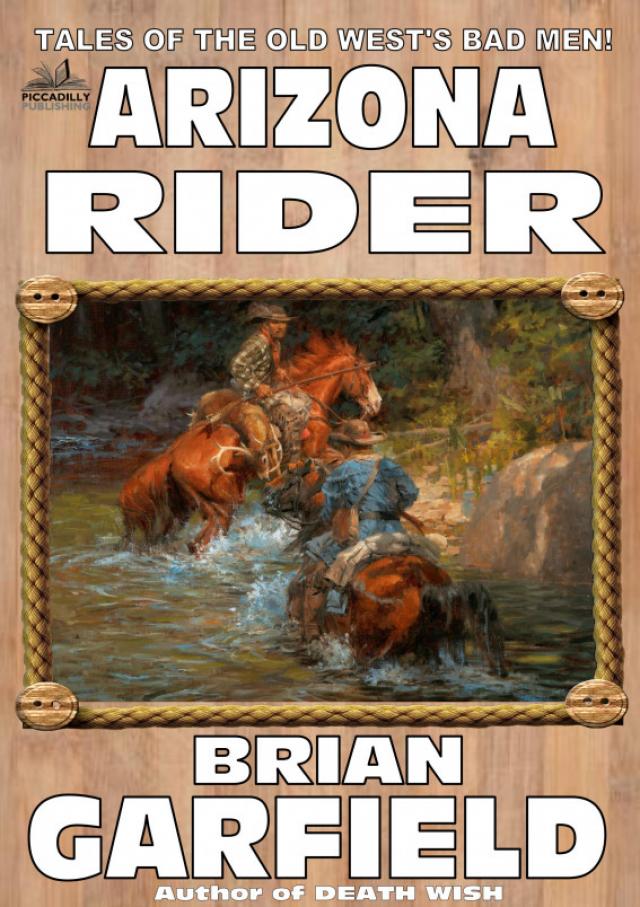
THE OUTLAWS 3: ARIZONA RIDER
Copyright ©, 1962, 2020 by Brian Garfield
This electronic edition published September 2020
Names, characters and incidents in this book are fictional, and any resemblance to actual events, locales, organizations, or persons living or dead is purely coincidental.
You may not copy, store, distribute, transmit, reproduce or otherwise make available this publication (or any part of it) in any form, or by means (electronic, digital, optical, photocopying, recording or otherwise), without the prior written permission of the publisher. Any person who does any unauthorized act in relation to this publication may be liable to criminal prosecution and civil claims for damages.
This is a Piccadilly Publishing Book / Text © Piccadilly Publishing
Our cover features a detail from Hunting in Hostile Territory, painted by Andy Thomas, and used by permission.
Andy Thomas Artist, Carthage Missouri. Andy is known for his action westerns and storytelling paintings and documenting historical events through history.
Visit www.piccadillypublishing.org to read more about our books
Chapter One
MARRINER RODE WITH his head tipped toward his chest, his horse’s hoofs making smudge prints in the hardpan. A brassy noon sun cast a harsh glare across the wide flats. The man’s hat brim rose once while he watched a hawk wheel against the intense blue sky, then he looked ahead with an expression that was almost insolent toward the upsurge of distant purple mountains. He thought, those must be the Patagonia Hills. I’m a long way from home. And he thought, too, of the creased, ragged paper in his pocket that had brought him all this way from Wyoming, across the mountains of Colorado and the high deserts of New Mexico to this jagged southern Arizona country.
He had memorized the contents of that letter and the part that stuck in his mind was the single phrase: Five thousand dollars. He grinned crookedly, realizing that he himself wasn’t worth the five thousand. It was his gun, and the deadly way he had of using it.
The envelope’s postmark was Washington Camp, Arizona Territory. And that was where Marriner was pointed now. At that place lived a man named Mike McKittrick, whom Marriner did not know and had never heard of, and McKittrick had his problems—problems that he would pay Marriner five thousand dollars to solve in a satisfactory and permanent way.
He tilted his hat forward over his lean face and shifted in the saddle, lifting his horse to a trot, wondering who the devil McKittrick was and just exactly what were the problems he had spoken of. Marriner was a short, compact man with a lean and wiry strength, his sharp-cut features dried by high-country winds. At thirty-one years of age, his black hair was shot with clean streaks of gray.
Suddenly he halted his horse at the lip of a steep drop of five hundred feet to the floor of a box-canyon running straight into the hills. At the start of a dim trail, he put the horse over the rim and went switchbacking down, leaning far back in the saddle, giving the gelding plenty of rein. At the bottom he proceeded at a steady gait into the rough country, judging his directions by guesswork and experience. Somewhere deep in this chain of rugged hills was Washington Camp. He hoped to reach the town by nightfall because he was tired of using his saddle for a pillow.
By mid-afternoon he was well into the mountains, pressing steadily deeper through jagged cross-canyons and undulating humps of brush-covered land. Vegetation varied from canyon to canyon. One was almost barren, littered with hat-sized rocks. The next was sparsely grown over by catclaw and sagebrush and sharp-petaled yucca. Once he dropped down the side of a mountain as far as a canyon bottom grown deep in cottonwood and sycamore. Here he found a clear water creek running thin; he watered the horse and dismounted to drink and wet his face, and climbed up again to splash across the river and look both ways along the canyon bottom before he proceeded westward into the higher reaches. The land seemed to tilt away from him in every direction—there was no flat spot in sight. He felt as if his sense of balance were betraying him, and he shook off the feeling with restless impatience.
He trotted down a gulch and broke out into a tiny green valley. There he found a rutted road running beside a tree-bordered, bubbling stream. A little farther on the road branched and he paused in the shade of a thick cottonwood to get his bearings and decide on which direction to travel. Towns were far between in this thinly settled part of the territory, and one of these roads had to lead to Washington Camp. The question was, which? From here the road pointed generally north and south, disappearing quickly over humps in both directions. Marriner hooked a leg over his saddle horn and spun up a cigarette, taking time to smoke it down to a stub, then he tossed the butt into the dirt road. The wind tilted the smoke southward and he made his decision, putting the horse onto the road heading south.
He hadn’t ridden fifty yards before the clop-clop of single-footing hoofs warned him of an approaching rider. At once he kneed his horse off the trail and into the shelter of the trees. Dismounting, he took a post behind a high brush clump, then leaned slightly forward, holding his animal’s nostrils to keep it from neighing.
Presently a rider appeared on the road. It soon became clear that the rider was a woman, small and straight-backed on the saddle of a gaited horse. She was apparently unarmed. Marriner straightened, mounted and put his horse around the trees and into the road.
His sudden approach, he had hoped, would startle the girl. If he had surprised her, she did not show it. She reined her horse down calmly and regarded Marriner from candid, unafraid eyes.
And he gave her as frank an appraisal as she was giving him. She was a small woman with a proud body and a face that owned more strength than beauty. Her chin was square but delicate, and her eyes were squinted against the brightness so that he could not tell their color. She wore a brown silk blouse and a divided brown riding skirt. Her rich brown hair hung down thickly behind her shoulders. Her eyes were slightly tilted at the corners, her hands sure on the reins.
The girl spoke first. “You’ll be Wes Marriner.”
It was Marriner’s turn to conceal his surprise. “Just so,” he said. “That was a quick guess.”
“It’s easy enough to tell, from the hang of your gun,” she said. “You’re painted with the same stripe as the rest of McKittrick’s boys.” There was no particular expression on her face or in her voice.
“Just what kind of stripe might that be, ma’am?”
“Call it a maverick stripe … to be polite,” the girl said. “How many guns does McKittrick intend to hire?”
He tilted his hat back and regarded her with his customary insolent smile; he folded his hands over the saddle horn and leaned forward. “Then I assume you’re not on McKittrick’s side?”
“That’s a pretty safe assumption,” she said, with a faint twist of her lips as though she were smiling in spite of herself. “McKittrick’s been making a brag for three weeks about you. He’s been threatening everybody in these hills with your name. He seems to think all he has to do is say ‘Wes Marriner’ and we’ll all dive under the table.”
“Sounds like this McKittrick’s got a good-sized war on his hands,” Marriner observed. “Where do you fit in?”
“I don’t,” she said. “That’s why McKittrick wants us out.”
The girl was lifting her reins, about to ride on when Marriner put up his hand. “Wait a minute. Who are you?”
“I’m Celia Pendleton,” she said. This time, her smile was plainly sardonic. “You’ll find out about the Pendletons, too, I expect.”
“I’ve met people freer with information,” he told her.
“I wouldn’t want to confuse you,” she said with mock sweetness. “I’m sure you won’t get the same story from McKittrick that you’d get from me.”
“Then,” he answered, “maybe I ought to hear your side of it.”
“What for? McKittrick’s hiring your gun, not your conscience.” The girl turned her horse quickly and, lifting it to a high canter, went on up the road to the north. Marriner, left breathing her dust, wondered why he hadn’t asked the way to Washington Camp. He shrugged, and decided to proceed southward. He wanted to see the girl again; she had whetted his interest; but he had a man to see first, an appointment to keep. And so he put his eyes on the southern hills and his horse along the rutted wagon tracks until, forty minutes later, the road dropped him to Washington Camp.
The town wasn’t an impressive sight. Buildings were scattered among the trees without apparent pattern. Dominating the scene was a high adobe building with a wide two-story wooden false-front. Faded red-painted lettering announced that this was Maldonado’s Saloon. Another smaller sign said Cantina, probably for the benefit of Mexican patrons. A litter of other buildings extended back into the trees.
Marriner rode slowly toward Maldonado’s, his senses attuned to the hardly perceptible signals of impending danger that always rode with him. He kept his eyes and ears busy while he made a place at the hitching rail for his horse and then stepped onto the board porch of the saloon, touching the smooth walnut grip of his Colt.
He stood beside the batwing doors, resting his back against the wall while he did two things: he swept the entire area in sight, the late-afternoon shadows and tree-pockets and building corners. Then he shut his eyes for a full two minutes, until he heard someone speak softly within the saloon, and sensed footfalls coming forward.
He turned quickly then, facing the doors, and opened his eyes while he pushed inside. He was now able to see quite well in the dimness of the saloon interior.
The room was long, wide, and low-ceilinged. The bar ran the length of the right-hand wall. There were no back-bar mirrors behind the shelves of whisky bottles and glasses. Nine men were in the room. Three of them were plainly hard rock miners and these he ignored immediately. One more was the bartender. A fifth was a grossly fat Mexican with shrewd, glinting eyes who sat in a back corner with his mustache drooping over fat jowls. The Mexican’s head rose, indicating a momentary interest in Marriner’s entrance, and then the Mexican’s head lowered again; he was working with a pencil in a large leather-bound ledger. That man, Marriner decided, would be Maldonado, who owned the saloon, according to the sign out front.
Of the other four men in the big room, he considered first the one who had been on his way to the door. All this observation on Marriner’s part took place within a single broken instant of time. That man, the one he now looked at, was arrested halfway from the middle of the bar to the door. He was, like one other at the bar, just an ordinary tough, and that was all. He was tall, where the other tough at the bar was only of average height; he was thick-muscled, where the other was thin. But both of them wore their guns in holsters in such a way that no one could miss their professions. They were two-bit gunmen. The one halfway across the floor now straightened and stood facing Marriner defensively, lifting his free left hand to scratch his whiskers.
Two more men stood farther back along the bar watching Marriner intently. One was a tall, gaunt figure of a man, a giant looming above the others, a man with the face of a hawk and obsidian, triangular eyes. That man’s black mustache and goatee were carefully trimmed in the manner of a Southern gentleman. He was perhaps forty, perhaps older; his wide shoulders stooped, his chest was a little hollow, and his broadcloth suit draped in a way that spoke plainly of wealth and his taste. He kept his unblinking stare on Marriner.
Standing beside the gaunt man was a middling-tall fellow with a pair of deadly gray eyes that were oddly mismatched by his soft, loose-hanging double chin. This man’s face was familiar to Marriner, the only one in the room he recognized. Habit made him conceal his surprise.
“Evenin’, Nash,” Marriner said.
Quincy Nash nodded, his bright gray eyes regarding Marriner with guarded hostility. “Wes,” he said, “how-do?”
“Friendly outfit you’ve got here,” Marriner observed, laying his contemptuous grin on the room in general. “You can all come back to life,” he said. “I don’t aim to bite anybody.”
“You came in kind of sudden,” Quincy Nash answered from across the length of the room.
“Try again,” Marriner said quietly. “I stood outside for three minutes after you heard my horse ride up. You had plenty of time for a look.”
“Sure,” Nash said. “Forget it, Wes.” Nash’s pink baby-skin and the softness of his round cheeks were deceptive. Marriner knew the man’s chunky body was packed solid with muscle, and that his hands were quick and sure at drawing the cross-belted .44’s at Nash’s hips. But Nash only smiled disarmingly and gestured toward the bar. “Been a long time, Wes. I’ll buy a drink.”
“Obliged,” Marriner said, and walked forward. His eyes remained on Nash but every man in the room was exactly placed in his mind, and the two tinhorn toughs were clear to his attention. Now, when he advanced, the tough who had been on his way to the door backed up two paces, turned around uncertainly and walked back by his partner at the bar. Then the pair stood with their backs to the bar, elbows hooked over edge, and turned their heads slowly to watch Marriner pass. Ignoring them, he stopped beside Quincy Nash at the back end of the bar. Behind Nash, almost touching Nash’s shoulder, stood the tall gaunt man in the broadcloth suit. That man’s eyes, unblinking and reptilian, never moved from Marriner’s face.
The bartender, a short dark man of obvious Indian blood, left a tumbler before Marriner with an inch of whisky in it. Marriner glanced at the whisky, and lifted his eyes again to Quincy. “Last time we met,” he said to Nash, “I put a bullet in your leg.”
“You hired out to one side,” Nash answered. “I hired out to the other. We were just doing our jobs. I don’t hold a grudge, Wes.” His baby-face broke into a disarming smile.
“All right,” Marriner said, not altogether convinced of Nash’s sincerity. He turned to the man and lifted the whisky glass. “How,” he said, drinking and glancing down the bar toward the two toughs. Both of them stood motionless, not speaking, watching him. He was on unfamiliar ground and he didn’t like the smell of this. He turned around, leaning the small of his back against the bar. Across the room in the dim corner the fat Mexican sat bowed over his ledger, his pencil poised, moving his lips slowly while he read something. The three miners sat around a table, their conversation suspended, watching Marriner with an obvious fear and resentment.
Marriner spoke in a very low tone, calculated to reach no farther than Quincy Nash’s ears: “Friendly camp, I see.”
“Sure,” Nash said idly. He stepped out from the bar and pointed toward the tall, gaunt man next to him. “I expect by now you two gents have had time to size each other up. This is Mike McKittrick.”
Marriner regarded the tall man evenly. He had begun to suspect that this silent, stooped figure with the triangular eyes must be McKittrick. Now McKittrick lowered his head in a slow-moving bow. The man’s voice, low and very confident, came rumbling out of the hollowness of his chest: “I didn’t expect you this soon.”
“I was out of work when your letter caught up to me,” Marriner said and awaited McKittrick’s further comment.
“You’ll want to know what the job is, of course,” McKittrick said. His tone was a little harsh; he treated men, Marriner could see, with a certain contempt.
“You’re supposed to stake a mining claim.”
Marriner’s eyebrows lifted slightly, otherwise he made no answer.
McKittrick touched his black goatee, and with the movement, Marriner caught the slight bulge near McKittrick’s armpit—a shoulder gun.
“Every man who stakes a mineral claim to a piece of land can get title to that land in two years,” McKittrick continued, “provided he stakes out not more than twenty-one acres, and provided he does a certain minimum amount of work. He’s got to dig a hole no smaller than eight-by-eight-by-four, and he’s got to make physical improvements amounting to not less than two hundred dollars.”
“All right,” Marriner said. “What of it?”
“I want you to stake a claim.”
“Sure,” Marriner said. His lips curled once more. “You’re paying me five thousand dollars to stake a claim.”
“Exactly.” McKittrick’s hawk-like face seemed a little amused.
“Am I supposed to laugh?” Marriner said; he heard Quincy Nash’s dry chuckle.
“Naturally,” McKittrick said imperturbably, “you’ll be expected to fight off trespassers and claim-jumpers.”
“Is it that hard to stake a claim around here?”
“Sometimes,” McKittrick said casually.
Marriner kept his grin. “What do you take me for?”
“What more do you need to know? All you have to do is stake a claim to land I point out to you. You’ll put up stone corner markers and you’ll file the claim with the government office. You’ll dig a hole and build a two-hundred-dollar cabin and after two years I’ll buy the claim from you.”
“For how much?”
“Five hundred dollars,” McKittrick said blandly. “That will be the amount on the quit-claim that you give me.”
“Where does the five thousand come in?’
“You get half of that in advance, the other half – two thousand plus the five hundred – when I buy the claim from you.” McKittrick watched him from shrewd eyes. “You don’t need to know any more than that.”